
Structural Engineering – Complete Design Example
RC Column Design: Longitudinal & Shear Reinforcement
Step-by-Step Solution with Tie Spacing Calculation
Problem Statement
Design a reinforced concrete rectangular column for a multi-story commercial building. The column must resist both axial load and minimum moment conditions. Calculate:
1. Longitudinal steel reinforcement (main bars)
2. Transverse reinforcement (ties/stirrups) for shear
Material Properties
| Property | Value | Description |
|---|---|---|
| Concrete Class | C25 | fck = 25 MPa |
| Steel Class | S420 | fyk = 420 MPa |
| fcd | 16.67 MPa | Design concrete strength (25/1.5) |
| fyd | 365 MPa | Design steel strength (420/1.15) |
| Cover | d’ = 25 mm | Concrete cover to main reinforcement |
Column Geometry and Loading
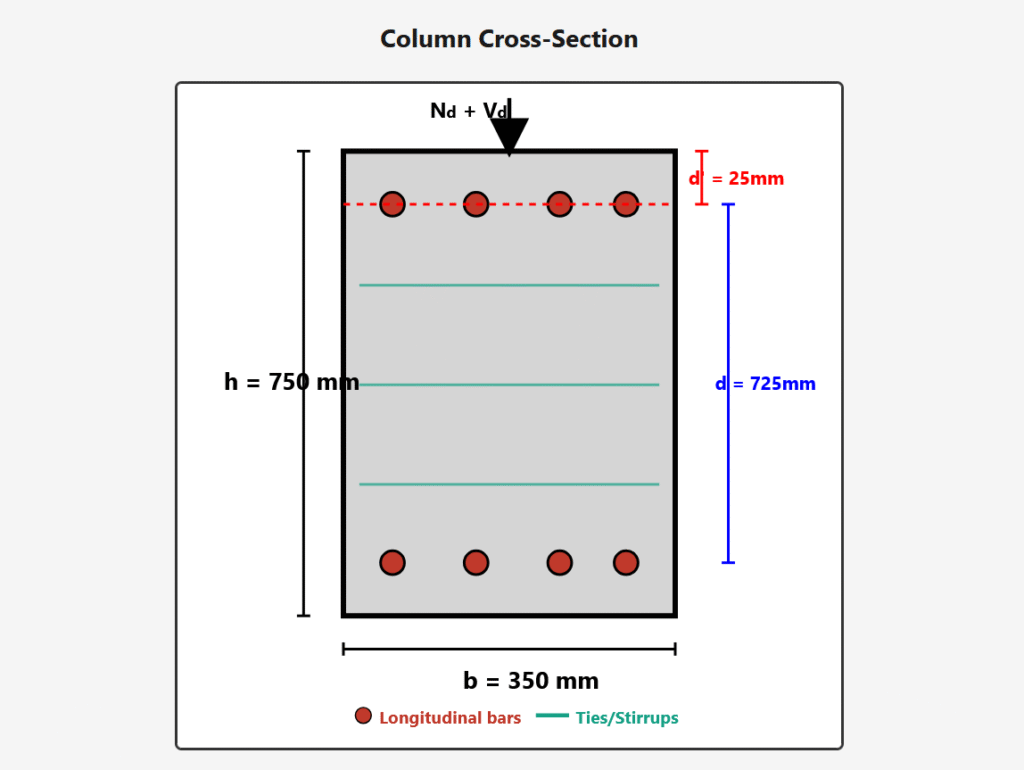
Column Cross-Section
Column Specifications:
- Width (b): 350 mm
- Height (h): 750 mm
- Cover (d’): 25 mm
- Effective depth (d): 750 – 25 = 725 mm
- Reinforcement: 8 longitudinal bars + transverse ties
Design Loading
| Load Type | Value |
|---|---|
| Axial Force (Nd) | 1150 kN |
| Minimum Moment Condition | emin = 15 + 0.03h |
| Shear Force (Vd) | 185 kN |
PART 1: LONGITUDINAL REINFORCEMENT DESIGN
Step 1
Calculate Minimum Eccentricity
emin = 15 + 0.03h
emin = 15 + 0.03 × 750
emin = 15 + 22.5 = 37.5 mm ≈ 38 mm
emin = 15 + 0.03 × 750
emin = 15 + 22.5 = 37.5 mm ≈ 38 mm
Why minimum eccentricity?
Even if the column is designed for purely axial load, codes require a minimum eccentricity to account for construction imperfections, material variations, and unforeseen moments. This ensures more realistic and safer design.
Even if the column is designed for purely axial load, codes require a minimum eccentricity to account for construction imperfections, material variations, and unforeseen moments. This ensures more realistic and safer design.
Step 2
Calculate Design Moment
Md = Nd × emin
Md = 1150 × 38
Md = 43,700 kN·mm = 43.7 kNm
Md = 1150 × 38
Md = 43,700 kN·mm = 43.7 kNm
Design moment:
This is the minimum bending moment that must be considered in the design, calculated from the axial load and minimum eccentricity. The column must resist both this moment and the axial force simultaneously.
This is the minimum bending moment that must be considered in the design, calculated from the axial load and minimum eccentricity. The column must resist both this moment and the axial force simultaneously.
Step 3
Calculate Normalized Parameters
d/h = 725/750 = 0.97
ν = Nd / (b × h × fcd)
ν = 1,150,000 / (350 × 750 × 16.67)
ν = 1,150,000 / 4,375,875
ν = 0.263 ≈ 0.26
μ = Md / (b × h² × fcd)
μ = 43.7 × 10⁶ / (350 × 750² × 16.67)
μ = 43.7 × 10⁶ / 3,281,906,250
μ = 0.0133 ≈ 0.013
ν = Nd / (b × h × fcd)
ν = 1,150,000 / (350 × 750 × 16.67)
ν = 1,150,000 / 4,375,875
ν = 0.263 ≈ 0.26
μ = Md / (b × h² × fcd)
μ = 43.7 × 10⁶ / (350 × 750² × 16.67)
μ = 43.7 × 10⁶ / 3,281,906,250
μ = 0.0133 ≈ 0.013
Dimensionless parameters: These ratios (ν for axial force, μ for moment) allow us to use standardized interaction diagrams to find the required steel reinforcement coefficient.
Step 4
Determine Steel Coefficient from Charts
With ν = 0.26, μ = 0.013, d/h = 0.97
From interaction diagram: ψ ≈ 0.08
Note: Since the moment is very small (minimum moment condition),
we will likely need minimum steel reinforcement.
From interaction diagram: ψ ≈ 0.08
Note: Since the moment is very small (minimum moment condition),
we will likely need minimum steel reinforcement.
Low moment case: The very small normalized moment (0.013) indicates this is primarily an axially loaded column with minimal bending. This typically results in minimum steel requirement.
Step 5
Calculate Required Steel Ratio
ρs = ψ × (fcd / fyd)
ρs = 0.08 × (16.67 / 365)
ρs = 0.08 × 0.0457
ρs = 0.00365 = 0.365%
ρs = 0.08 × (16.67 / 365)
ρs = 0.08 × 0.0457
ρs = 0.00365 = 0.365%
Check against code limits:
ρmin = 1.0%
ρmax = 4.0%
ρs,calculated = 0.365% < ρmin = 1.0%
→ Use ρmin = 1.0%
ρmin = 1.0%
ρmax = 4.0%
ρs,calculated = 0.365% < ρmin = 1.0%
→ Use ρmin = 1.0%
Step 6
Calculate Total Steel Area Required
Ast = ρs × b × h
Ast = 0.01 × 350 × 750
Ast = 2,625 mm²
Ast = 0.01 × 350 × 750
Ast = 2,625 mm²
Step 7
Select Bar Size and Number
Try n = 8 bars
Area per bar = Ast / n = 2,625 / 8 = 328 mm²
Required diameter:
Ø = √(4A/π) = √(4 × 328 / π) = √(417.8) = 20.4 mm
Select: Ø22 mm (next standard size up)
Verification:
Area of Ø22 = π × 22²/4 = 380 mm²
Total provided = 8 × 380 = 3,040 mm²
3,040 mm² > 2,625 mm² ✓
Area per bar = Ast / n = 2,625 / 8 = 328 mm²
Required diameter:
Ø = √(4A/π) = √(4 × 328 / π) = √(417.8) = 20.4 mm
Select: Ø22 mm (next standard size up)
Verification:
Area of Ø22 = π × 22²/4 = 380 mm²
Total provided = 8 × 380 = 3,040 mm²
3,040 mm² > 2,625 mm² ✓
Longitudinal Reinforcement: 8Ø22
Provided steel ratio: 3,040/(350×750) = 1.16% > 1.0% ✓
Provided steel ratio: 3,040/(350×750) = 1.16% > 1.0% ✓
PART 2: SHEAR REINFORCEMENT DESIGN (TIES)
Step 8
Check if Shear Reinforcement is Required
Calculate concrete shear capacity:
VRd = 0.22 × Asw × fcd
Where Asw is the area of shear reinforcement per unit length
For minimum shear capacity check:
Vd = 185 kN
Since we have shear force, we need to design ties.
VRd = 0.22 × Asw × fcd
Where Asw is the area of shear reinforcement per unit length
For minimum shear capacity check:
Vd = 185 kN
Since we have shear force, we need to design ties.
Step 9
Calculate Required Tie Area
For shear design, calculate effective depth:
d = h – d’ = 750 – 25 = 725 mm
Check concrete alone capacity:
Vcr = 0.65 × fctd × b × d × (1 + 0.07 × Nd/Ac)
Where fctd = 1.15 MPa (for C25)
Vcr = 0.65 × 1.15 × 350 × 725 × (1 + 0.07 × 1150×10³/(350×750))
Vcr = 0.65 × 1.15 × 350 × 725 × (1 + 0.07 × 4.38)
Vcr = 190,344 × 1.307
Vcr = 248,720 N = 248.7 kN
Since Vd = 185 kN < Vcr = 248.7 kN
→ Minimum shear reinforcement required
d = h – d’ = 750 – 25 = 725 mm
Check concrete alone capacity:
Vcr = 0.65 × fctd × b × d × (1 + 0.07 × Nd/Ac)
Where fctd = 1.15 MPa (for C25)
Vcr = 0.65 × 1.15 × 350 × 725 × (1 + 0.07 × 1150×10³/(350×750))
Vcr = 0.65 × 1.15 × 350 × 725 × (1 + 0.07 × 4.38)
Vcr = 190,344 × 1.307
Vcr = 248,720 N = 248.7 kN
Since Vd = 185 kN < Vcr = 248.7 kN
→ Minimum shear reinforcement required
Result: The concrete capacity exceeds the design shear force, but code requires minimum shear reinforcement in all columns for ductility and confinement.
Step 10
Design Minimum Ties
Try Ø10 ties (2-leg stirrups)
Asw = 2 × (π × 10²/4) = 2 × 78.5 = 157 mm²
For minimum reinforcement:
(Asw/s) ≥ 0.3 × (fctd/fywd) × b
Where fywd = 365 MPa, fctd = 1.15 MPa
(157/s) ≥ 0.3 × (1.15/365) × 350
(157/s) ≥ 0.330
s ≤ 157/0.330 = 475 mm
Asw = 2 × (π × 10²/4) = 2 × 78.5 = 157 mm²
For minimum reinforcement:
(Asw/s) ≥ 0.3 × (fctd/fywd) × b
Where fywd = 365 MPa, fctd = 1.15 MPa
(157/s) ≥ 0.3 × (1.15/365) × 350
(157/s) ≥ 0.330
s ≤ 157/0.330 = 475 mm
Code maximum spacing limits:
s ≤ b/2 = 350/2 = 175 mm
s ≤ 12Ømin = 12 × 22 = 264 mm (min. longitudinal bar)
s ≤ 200 mm (general limit for columns)
Governing: s ≤ 175 mm
Select: s = 150 mm (standard spacing)
s ≤ b/2 = 350/2 = 175 mm
s ≤ 12Ømin = 12 × 22 = 264 mm (min. longitudinal bar)
s ≤ 200 mm (general limit for columns)
Governing: s ≤ 175 mm
Select: s = 150 mm (standard spacing)
Transverse Reinforcement: Ø10 @ 150 mm
(Two-leg stirrups at 150 mm spacing)
(Two-leg stirrups at 150 mm spacing)
Final Design Summary
| Design Element | Requirement | Provided | Status |
|---|---|---|---|
| Column dimensions | 350 × 750 mm | 350 × 750 mm | ✓ |
| Axial load capacity | Nd = 1,150 kN | Adequate | ✓ |
| Moment capacity | Md = 43.7 kNm | Adequate | ✓ |
| Steel area required | 2,625 mm² | 3,040 mm² | ✓ |
| Steel ratio | ρmin = 1.0% | 1.16% | ✓ |
| Longitudinal bars | 8Ø22 | 8Ø22 | ✓ |
| Shear capacity | Vd = 185 kN | Vcr = 248.7 kN | ✓ |
| Ties/Stirrups | Min. required | Ø10 @ 150 mm | ✓ |
Design Verification Checklist
Longitudinal Reinforcement:
- Number of bars: 8 bars (adequate for rectangular column) ✓
- Bar diameter: Ø22 mm (standard size) ✓
- Steel ratio: 1.16% (between 1% and 4% limits) ✓
- Clear spacing: (350 – 2×25 – 4×22)/(3) = 71 mm > 25 mm ✓
- Bar distribution: 4 bars on each long face ✓
Transverse Reinforcement:
- Tie diameter: Ø10 mm (≥ Ø8 mm minimum) ✓
- Tie spacing: 150 mm (≤ 175 mm maximum) ✓
- Configuration: Closed rectangular ties ✓
- Number of legs: 2 (adequate for this width) ✓
Detailing Requirements:
- Concrete cover: 25 mm (adequate for indoor exposure) ✓
- Tie hooks: 135° hooks with 10Ø extensions ✓
- Corner bars: All corner positions have longitudinal bars ✓
Key Design Points
- Minimum moment condition: The column is designed for minimum eccentricity (38 mm) resulting in small moment (43.7 kNm)
- Axial load dominance: Normalized axial force ν = 0.26 indicates moderate compression
- Minimum steel controls: Calculated steel (0.365%) is less than code minimum (1.0%)
- Shear capacity: Concrete alone provides 248.7 kN > 185 kN required, but minimum ties still needed
- Tie spacing: Governed by b/2 = 175 mm; using 150 mm for better confinement
- Practical design: 8 bars provide symmetric arrangement and ease of construction
Construction Drawing Specification
COLUMN DIMENSIONS: 350 × 750 mm
LONGITUDINAL REINFORCEMENT: 8Ø22
TRANSVERSE REINFORCEMENT: Ø10 @ 150 mm c/c
CONCRETE GRADE: C25 (fck = 25 MPa)
STEEL GRADE: S420 (fyk = 420 MPa)
CONCRETE COVER: 25 mm
TIE HOOKS: 135° with 10Ø extension