
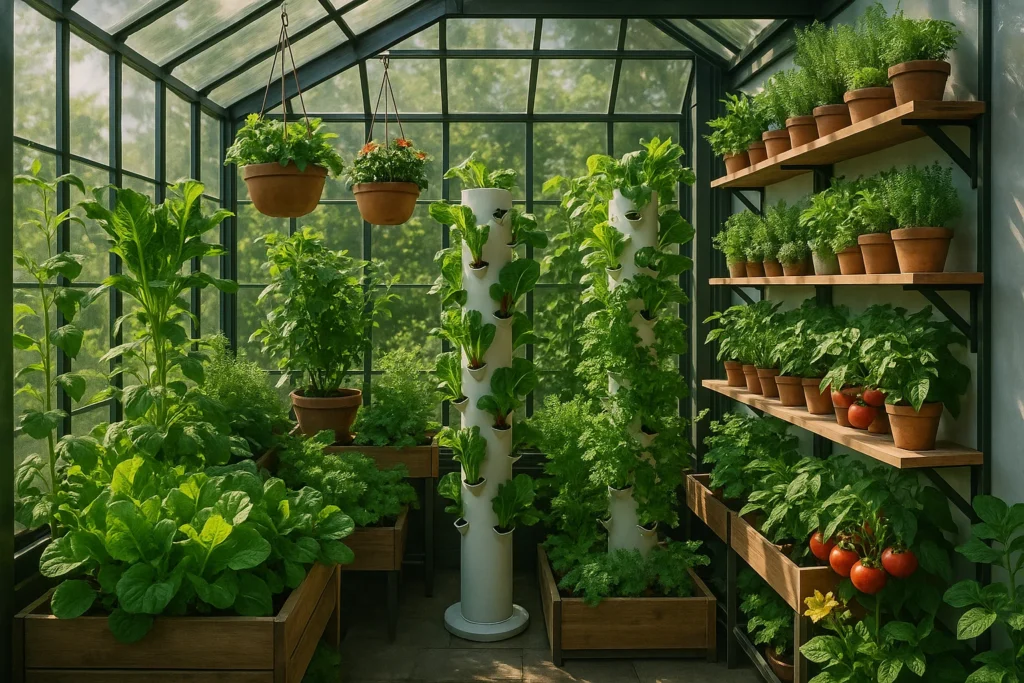
Small Greenhouse Space Maximization: Vertical Growing & Smart Layout Mastery
🚀 Revolutionary Space Utilization
Small greenhouse operators are achieving yields that rival commercial operations through vertical growing systems, companion planting strategies, and sophisticated rotation schedules. These techniques can triple production capacity without expanding greenhouse footprint, turning space limitations into productivity advantages.
Space Efficiency Calculator
📏 Calculate Your Space Utilization Potential
Greenhouse Dimensions
🌱 Your Space Optimization Results
48 sq ft
36 sq ft
288 cubic ft
18 plants
65 plants
261%
Vertical Growing System Planner
⬆️ Choose Your Vertical Growing Solutions
Trellis Systems
Best For: Climbing crops
Plants: Beans, peas, cucumbers, tomatoes
Cost: $50-200
Tower Gardens
Best For: Leafy greens, herbs
Plants: Lettuce, spinach, kale, basil
Cost: $100-400
Wall Pockets
Best For: Herbs, strawberries
Plants: Oregano, thyme, parsley, mint
Cost: $30-150
Hanging Systems
Best For: Trailing plants
Plants: Cherry tomatoes, trailing herbs
Cost: $25-100
Your Vertical Growing Plan
Companion Planting Matrix
🤝 Optimize Plant Partnerships for Space Efficiency
Crop Rotation Planner
🔄 Plan Your Year-Round Production Cycles
Cycle
Leafy Greens
Cool Season
Fruiting Crops
Warm Season
Root Vegetables
Storage Crops
Legumes
Soil Building
Current Quarter Focus
Focus on cool-season crops like lettuce, spinach, kale, and herbs. These plants thrive in lower light and cooler temperatures, making them perfect for extending the growing season.
Layout Optimizer
🏗️ Design Your Optimal Greenhouse Layout
Climbing Crops
Leafy Greens
Mixed Vegetables
Wall Pockets
Layout Analysis
Productivity Enhancement Tracker
📈 Monitor Your Space Optimization Progress
| Space Optimization Method | Space Efficiency Gain | Implementation Cost | Maintenance Level | Best Plant Types | Skill Level Required |
|---|---|---|---|---|---|
| Vertical Trellises | 200-400% | $50-200 | Medium | Vining crops, climbers | Beginner-Intermediate |
| Tower Gardens | 300-500% | $100-400 | Medium-High | Leafy greens, herbs | Intermediate |
| Wall Pocket Systems | 150-250% | $30-150 | Low | Herbs, strawberries | Beginner |
| Companion Planting | 50-100% | $0-50 | Low | Compatible vegetables | Beginner-Intermediate |
| Succession Planting | 100-200% | $20-100 | Medium | Quick-growing crops | Intermediate |
| Hydroponic Vertical | 400-600% | $200-800 | High | Most vegetables, herbs | Advanced |
🎯 Your Space Maximization Strategy
Successful small greenhouse operators combine multiple space-saving techniques rather than relying on single approaches. Start with vertical trellises for immediate space gains, add companion planting for efficiency improvements, then implement rotation schedules for year-round productivity. This layered approach maximizes plant capacity while maintaining healthy growing conditions and manageable maintenance requirements.
Transform limited greenhouse space into productive growing systems with vertical gardening techniques, companion planting strategies, and rotation schedules that maximize yields regardless of size
Standing in the center of a cramped 8×10 greenhouse in downtown Chicago, surrounded by towering apartment buildings that blocked precious sunlight for half the day, Maria Gonzalez faced the same challenge that thousands of urban American gardeners confront daily: how to grow enough food in impossibly small spaces. What started as frustration over her limited floor space became a revelation that changed everything. By growing upward instead of outward, using every vertical inch from floor to ceiling, she discovered that space constraints weren’t limitations—they were opportunities for innovation.
Within six months, Maria’s tiny greenhouse was producing more fresh vegetables than her neighbor’s traditional 20×30 structure. Vertical towers of herbs cascaded from ceiling-mounted systems, trellises supported climbing beans and cucumbers that reached the rafters, and strategic companion planting created micro-ecosystems where every square inch served multiple purposes. Her transformation illustrates what’s happening across America as greenhouse gardeners realize that productivity isn’t determined by square footage—it’s determined by smart space utilization and creative growing systems.
This revolution in small-space growing is particularly relevant for American gardeners facing rising real estate costs, urban density, and the desire for year-round local food production. From Brooklyn balconies to suburban Phoenix backyards, creative growers are proving that limited space can yield unlimited potential when approached with the right techniques and strategies.
The Vertical Growing Revolution
The magic of vertical gardening lies in its fundamental reimagining of growing space. Traditional horizontal gardening treats greenhouse floor area as the primary limitation, but vertical systems recognize that cubic space, not square footage, determines growing capacity. This three-dimensional approach can triple or quadruple production capacity without expanding the greenhouse footprint—a critical advantage for American gardeners dealing with zoning restrictions, high land costs, or limited backyard space.
Professional vertical growers understand that different plants naturally occupy different vertical zones. Climbing species like beans, peas, and cucumbers evolved to reach upward, making them perfect candidates for trellis systems that can extend from ground level to greenhouse ceiling. These vigorous climbers can produce impressive yields when given proper vertical support—a single cucumber vine grown vertically can yield 10-15 pounds of fruit in a season while occupying less than one square foot of floor space.
The key to successful vertical growing lies in understanding how different plant types interact with vertical space. Vining crops naturally climb and require strong support structures that can handle significant weight as plants mature and fruit develops. Leafy greens and herbs adapt well to pocket systems or modular planters that can be stacked or mounted on walls, creating living walls that serve both productive and aesthetic purposes. Compact varieties of typically spreading plants—like determinate tomatoes, dwarf peppers, or bush-type squash—can thrive in tiered systems that maximize growing density without sacrificing plant health.
Sarah Kim’s transformation of her 6×8 lean-to greenhouse in suburban Seattle demonstrates the power of strategic vertical planning. Starting with a traditional layout that accommodated maybe 20 plants, she redesigned the space using a combination of wall-mounted growing pockets for herbs, sturdy trellises for climbing crops, and tiered shelving systems for compact vegetables. The result was stunning: her redesigned space now supports over 80 productive plants while actually improving air circulation and plant health. Her herb wall alone produces enough basil, cilantro, parsley, and oregano to supply her family year-round plus generate extra income through farmers market sales.
The structural requirements for successful vertical systems demand careful planning and quality materials. Trellises must support not just the weight of mature plants but also the dynamic loads created by wind, watering, and harvesting activities. A fully loaded cucumber trellis can easily support 50-100 pounds of plant material and fruit, requiring anchor points that transfer this weight safely to the greenhouse frame or foundation. Many American greenhouse manufacturers now offer integrated trellis systems designed specifically for their structures, but creative builders can adapt these concepts using galvanized steel wire, treated lumber, or powder-coated aluminum components that resist greenhouse humidity and temperature fluctuations.
Wall-mounted pocket systems require different structural considerations. These modular units must distribute weight evenly across mounting surfaces while providing adequate drainage to prevent water damage to greenhouse walls. Professional installations often use French cleat systems or heavy-duty brackets that can be adjusted as plants grow and system requirements change. The beauty of modular pocket systems lies in their flexibility—units can be reconfigured seasonally, removed for maintenance, or expanded as space and budget allow.
Successful vertical gardeners also master the art of plant selection and placement. Understanding each crop’s light requirements becomes critical when plants are arranged in vertical layers. Sun-loving crops like tomatoes and peppers occupy the brightest upper positions, while shade-tolerant leafy greens thrive in lower tiers where they receive filtered light. This natural layering mimics forest ecosystems and creates growing conditions that actually improve plant health compared to traditional single-layer arrangements.
The watering and nutrition challenges of vertical systems require specialized approaches that many beginners overlook. Gravity-fed drip systems work exceptionally well for vertical arrangements, providing consistent moisture to all levels while minimizing water waste. However, upper tiers tend to dry out faster due to increased air circulation and heat accumulation near greenhouse peaks, requiring zone-specific watering schedules or different emitter types for different levels.
Nutrient management in vertical systems also demands attention to how feeding solutions move through the growing medium. In tower systems or stacked planters, nutrients applied to upper levels gradually filter down, creating concentration gradients that can leave lower plants overfed while upper plants struggle with deficiencies. Professional growers address this by using individual fertigation systems for each tier or by rotating plant positions periodically to ensure equal access to nutrients.
Smart Plant Arrangements That Maximize Every Square Inch
Beyond vertical growing, the strategic arrangement of plants within available space can dramatically increase productivity through companion planting, intercropping, and succession planning. These techniques, refined by generations of American market gardeners, create symbiotic relationships between plants that improve yields while reducing pest problems and resource competition.
Companion planting in greenhouse environments works differently than in outdoor gardens, where natural predator-prey relationships and soil microorganisms play larger roles. Inside greenhouses, companion benefits focus primarily on spatial efficiency, pest deterrence through aromatic plants, and complementary growth habits that allow multiple crops to share limited space without competing.
The classic tomato-basil partnership exemplifies greenhouse companion planting at its best. Beyond the culinary compatibility that makes this pairing popular with home cooks, these plants create practical growing advantages in confined spaces. Basil’s compact growth habit allows it to occupy ground space around tomato plants without competing for light, while its aromatic oils help repel aphids, whiteflies, and other common greenhouse pests that target tomatoes. This natural pest management reduces the need for interventions that can be problematic in enclosed greenhouse environments.
More sophisticated intercropping systems layer multiple crops with different growth habits and timing. Fast-growing radishes can be planted between slower-maturing carrots, utilizing the same soil space twice within a single growing season. Lettuce and spinach planted beneath trellised cucumbers take advantage of the partial shade that cucumber vines provide, extending the growing season for cool-weather crops even during hot summer months. These strategic combinations require careful timing and variety selection but can effectively double the productivity of limited growing space.
Staggered row planting takes spatial efficiency beyond simple intercropping by optimizing light penetration and air circulation. Instead of traditional parallel rows, staggered arrangements position plants in offset patterns that eliminate the straight-line shadows that reduce photosynthesis in conventional layouts. This technique proves especially valuable in smaller greenhouses where every plant must receive optimal light to justify its space allocation.
The implementation of staggered systems requires understanding how plant canopies develop over time. Young transplants positioned in tight staggered patterns will eventually fill the available space, creating a continuous canopy that maximizes light interception. However, this same dense planting can create air circulation problems if not managed properly through selective pruning and strategic spacing adjustments as plants mature.
Professional growers monitor their plant arrangements continuously, adjusting spacing and pruning selectively to maintain optimal growing conditions as seasons progress. Plants that exceed expected growth rates get relocated or pruned back, while slower-growing specimens might be moved to better positions or supplemented with additional feeding to catch up with their neighbors. This active management approach treats the greenhouse as a dynamic system rather than a static arrangement, maximizing productivity through responsive adjustments.
Container systems add another layer of flexibility to small greenhouse management by allowing rapid rearrangement of plant positions as conditions change. Lightweight containers enable growers to optimize sun exposure throughout the day by moving plants to track available light, particularly valuable in urban environments where surrounding buildings create shifting shadow patterns. However, container growing requires more intensive water and nutrient management since plants cannot access soil reserves and depend entirely on what growers provide.
The choice of container size and type significantly impacts plant performance and space efficiency. Large containers support bigger plants and provide more stable root environments but consume valuable floor space and require more growing medium. Smaller containers maximize plant density but demand more frequent watering and feeding while limiting the size of crops that can be grown successfully. Successful small greenhouse operators often use a mixed approach, with large containers for long-season crops like tomatoes and peppers, medium containers for herbs and leafy greens, and small containers for quick-turnover crops like microgreens and sprouts.
Efficient Layouts That Streamline Operations
The physical layout of small greenhouses determines not only how many plants can be grown but also how efficiently daily maintenance tasks can be accomplished. Professional designers approach greenhouse layouts like industrial engineers, analyzing workflow patterns and optimizing movement paths to minimize time and energy expenditure while maximizing plant access and care quality.
Pathway planning forms the foundation of efficient greenhouse layouts. Paths must be wide enough to accommodate the tools and equipment used regularly—watering cans, wheelbarrows, harvest containers, and maintenance supplies—while consuming minimal floor space. The standard recommendation of 18-24 inch wide main paths works well for most small greenhouse operations, but these dimensions can be adjusted based on specific needs and physical limitations of the primary users.
Traffic flow analysis reveals optimization opportunities that aren’t immediately obvious. Mapping typical daily, weekly, and seasonal movement patterns shows which areas get accessed most frequently and which paths carry the heaviest traffic loads. High-traffic areas benefit from wider paths and more durable flooring materials, while occasional-access areas can utilize narrower paths to maximize growing space. This analysis often reveals opportunities to relocate storage areas, workbenches, or less-frequently tended plants to improve overall efficiency.
Zoning strategies group plants with similar care requirements, reducing the time and complexity involved in daily maintenance routines. Moisture-loving crops clustered in one area can be watered more heavily and frequently than drought-tolerant plants in another zone. Sun-loving plants positioned in the brightest locations receive maximum light exposure while shade-tolerant crops occupy areas with partial or filtered light. This approach not only optimizes growing conditions for each plant type but also simplifies care routines by eliminating the need to provide different treatments to individual plants scattered throughout the greenhouse.
The implementation of plant zones requires understanding microclimates within small greenhouse spaces. Areas near south-facing walls typically receive more heat and light than northern exposures, making them ideal for warm-season crops that benefit from extra thermal mass. Corners and areas near doors experience more temperature fluctuations and may be better suited for hardy crops that tolerate variable conditions. Elevated areas near the greenhouse peak accumulate heat and may dry out faster, while ground-level areas stay cooler and retain moisture longer.
Workspace organization dramatically impacts operational efficiency in small greenhouses where every square foot serves multiple purposes. Integrated workbenches that combine potting surfaces with tool storage and supply organization eliminate the need for separate storage buildings or areas. Mobile work surfaces can be moved to where they’re needed most, then stored compactly when not in use. Vertical storage systems keep frequently used tools and supplies within easy reach while consuming minimal floor space.
The evolution of Richard Martinez’s 10×12 greenhouse in Albuquerque illustrates how thoughtful layout planning can transform cramped spaces into highly productive operations. Initially arranged with traditional benches around the perimeter, the space felt crowded and difficult to work in despite having adequate growing capacity. By switching to a central aisle design with growing areas on both sides, he improved access to all plants while creating a more spacious feeling. The addition of overhead storage for seasonal items and wall-mounted tool organization freed up valuable bench space for plant propagation and daily tasks.
Climate control considerations become more complex in efficiently designed small greenhouses where plant density is maximized. Dense plantings can create dead air spaces that promote fungal diseases and pest problems, requiring enhanced ventilation systems or strategic fan placement to maintain air movement. Heat distribution may become uneven when plants are arranged in complex patterns, necessitating careful monitoring and possibly supplemental heating or cooling in specific zones.
Year-Round Production Through Strategic Crop Rotation
Continuous production in small greenhouse spaces requires sophisticated planning that maximizes the productivity of every growing area throughout the year. Unlike outdoor gardens where seasonal limitations create natural breaks in production, controlled greenhouse environments enable year-round growing if properly managed through strategic crop rotation, succession planting, and seasonal adaptation techniques.
The principles of greenhouse crop rotation differ significantly from field agriculture due to the controlled environment and typically soilless growing media used in most small greenhouse operations. Rather than focusing primarily on soil health and nutrient management, greenhouse rotation emphasizes pest and disease cycle disruption, optimal use of seasonal light and temperature conditions, and continuous space utilization that maximizes annual yields from limited growing areas.
Temperature-based rotation strategies align crop selection with natural seasonal variations even within heated greenhouse environments. Cool-season crops like lettuce, spinach, and radishes perform best during months when outside temperatures reduce greenhouse heating costs and natural light levels suit their growth patterns. Warm-season crops including tomatoes, peppers, and cucumbers thrive during periods when abundant sunlight and natural warmth support vigorous growth without excessive heating costs.
The timing of these transitions requires understanding both crop maturation schedules and environmental conditions throughout the year. Cool-season plantings typically begin in late summer for fall harvest, continue through winter for steady production, then wind down in early spring as increasing temperatures and light levels favor warm-season alternatives. This transition period offers opportunities for quick-growing crops like microgreens, herbs, or baby vegetables that can bridge the gap between major plantings.
Advanced rotation systems incorporate multiple crop types with different maturation schedules to ensure continuous harvest throughout the year. Fast-growing crops like lettuce, radishes, and spinach can be succession planted every two to three weeks, providing steady harvests while slower-growing crops like tomatoes and peppers occupy the same space. Companion crops with complementary growing seasons can share space sequentially—early spring peas followed by summer beans on the same trellis system, or cool-season herbs replaced by heat-tolerant varieties as temperatures increase.
The implementation of these complex rotation systems requires detailed record keeping and forward planning that many casual greenhouse gardeners overlook. Successful operators maintain planting calendars that project space availability, succession schedules, and harvest timing months in advance. This planning reveals opportunities for optimizing space utilization and identifies potential bottlenecks where space conflicts might arise.
Lisa and Tom Chen’s year-round operation in their 8×16 greenhouse outside Portland demonstrates how systematic planning can create remarkable productivity from limited space. Their rotation system divides the greenhouse into four zones, each following a different seasonal schedule that ensures continuous production. Zone 1 focuses on cool-season leafy greens with succession plantings every three weeks. Zone 2 rotates between spring peas, summer tomatoes, and fall peppers. Zone 3 specializes in herbs with seasonal variety changes, while Zone 4 serves as a propagation area and seasonal overflow space.
This systematic approach enables them to harvest fresh vegetables every week of the year while maintaining soil health through diverse plantings and organic matter additions. Their detailed records show average monthly harvests of 25-30 pounds of mixed vegetables from their 128 square foot growing space—yields that rival commercial greenhouse operations on a per-square-foot basis.
The challenges of intensive year-round production require proactive management of plant health, pest control, and resource utilization. Continuous cropping can lead to accelerated pest reproduction and disease transmission if not carefully managed through sanitation practices, resistant varieties, and biological controls. Nutrient management becomes more complex when multiple crops with different requirements share limited growing media, often requiring customized fertilization programs and periodic media replacement or amendment.
Water usage intensifies with continuous production, making efficient irrigation systems and water recycling increasingly important for both economic and environmental reasons. Many successful year-round operators implement rainwater collection, greywater recycling, or closed-loop hydroponic systems that minimize waste while ensuring consistent plant nutrition.
The economic benefits of year-round production extend beyond simple yield increases to include reduced grocery expenses, potential income from surplus sales, and the satisfaction of food security throughout seasonal variations. Many small greenhouse operators find that systematic year-round production pays for greenhouse infrastructure and operating costs within two to three years while providing premium fresh vegetables that would otherwise cost hundreds of dollars annually at retail prices.
Modern technology increasingly supports sophisticated rotation planning through software applications that track planting schedules, predict harvest dates, and optimize space allocation algorithms. These tools help overcome the complexity barriers that historically limited intensive rotation systems to commercial operations, making advanced techniques accessible to dedicated home greenhouse gardeners who want to maximize their investment in controlled growing environments.
The transformation from traditional seasonal growing to sophisticated year-round production represents a fundamental shift in thinking about greenhouse space utilization. Rather than accepting natural limitations, innovative growers create their own seasonal rhythms optimized for continuous productivity, maximum space efficiency, and sustainable resource management. This approach turns small greenhouse spaces into highly productive food systems capable of supporting household nutrition needs while demonstrating the remarkable potential of intensive, well-planned growing systems.