
Column Shear Reinforcement Design (Transverse Reinforcement)
Design of Stirrups/Ties for Rectangular Column
Problem Statement
For the rectangular column designed in the previous example (400 mm × 600 mm with 8Ø20 longitudinal reinforcement), calculate the required transverse reinforcement (stirrups/ties) to resist the design shear force.
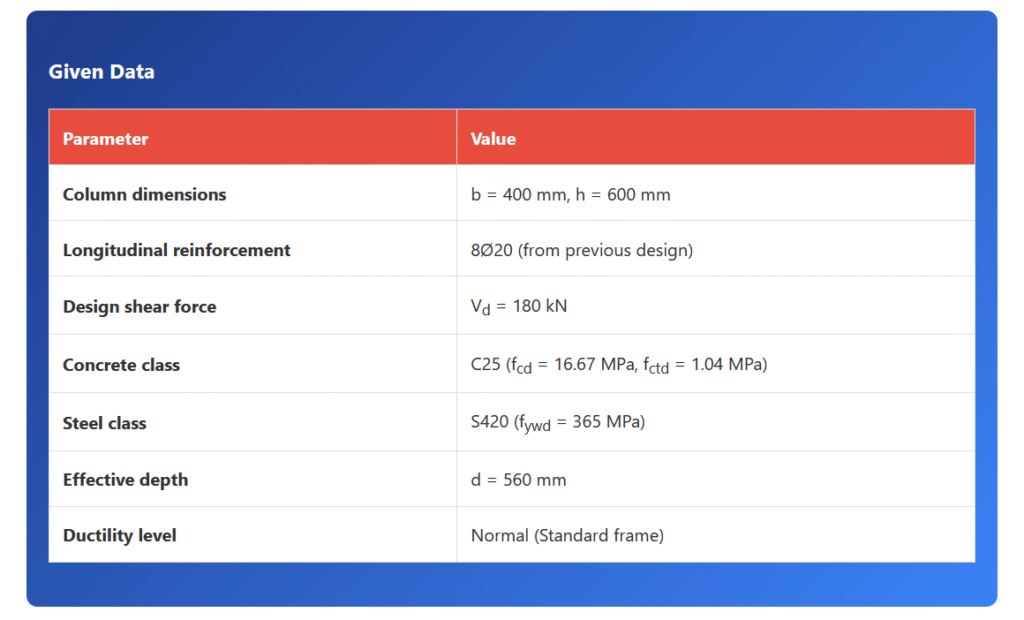
Given Data
| Parameter | Value |
|---|---|
| Column dimensions | b = 400 mm, h = 600 mm |
| Longitudinal reinforcement | 8Ø20 (from previous design) |
| Design shear force | Vd = 180 kN |
| Concrete class | C25 (fcd = 16.67 MPa, fctd = 1.04 MPa) |
| Steel class | S420 (fywd = 365 MPa) |
| Effective depth | d = 560 mm |
| Ductility level | Normal (Standard frame) |
THEORY – Shear Resistance in Columns
Maximum Shear Force Check
The column must satisfy the condition:
Note: If this condition is NOT satisfied, dimensions must be increased.
If satisfied: Calculate the required shear reinforcement considering the cracking contribution of concrete.
Shear Resistance Components
Where:
Vc = Concrete contribution to shear resistance
Vs = Stirrup/tie contribution to shear resistance
For Normal Ductility Level Columns:
Concrete Contribution:
Vcr = Vd – Vc (kN)
Stirrup Spacing:
Design Regions for Columns
CONFINEMENT ZONE (Near beam-column joints):
- Length = max(b/3, 8Ølong, 150 mm)
- Stricter spacing requirements
- s ≤ min(b/2, 12Ømin, 200 mm)
- Asw/sc ≥ 0.3 (fcd/fywd) b (minimum)
MIDDLE REGION:
- Less critical area
- s ≤ min(b/2, 12Ømin, 200 mm)
- Asw/so ≥ 0.3 (fcd/fywd) b
SOLUTION – Step by Step Design
Check Maximum Shear Force Capacity
Ac = b × h = 400 × 600 = 240,000 mm²
fcd = 16.67 MPa
0.22 Ac fcd = 0.22 × 240,000 × 16.67
= 879,648 N = 879.6 kN
Vd = 180 kN < 879.6 kN ✓
Calculate Required Stirrup Area for Shear
Concrete contribution to shear resistance:
For this example (no significant axial compression effect):
Vc = 0.8 × Vcr
Simplified calculation (conservative approach):
Vc ≈ 0.8 × 0.65 × 1.04 × 400 × 560
= 0.8 × 152,064 N = 121.7 kN
Required stirrup contribution:
Vs = 180 – 121.7 = 58.3 kN
The concrete alone can resist 121.7 kN of shear. We need stirrups to provide an additional 58.3 kN of shear resistance.
Calculate Required Stirrup Spacing
Let’s try Ø10 two-legged stirrups:
Two-legged stirrup: Asw = 2 × 78.5 = 157 mm²
Required spacing from shear:
s = (Asw × fywd × d) / Vs
s = (157 × 365 × 560) / (58,300)
s = 32,095,600 / 58,300
s = 550 mm
Apply Maximum Spacing Limits
Confinement Zone Requirements:
= max(400/3, 8×20, 150)
= max(133, 160, 150)
= 160 mm from column end
Maximum spacing in confinement zone:
sc ≤ min(b/2, 12Ømin, 200 mm)
= min(400/2, 12×10, 200)
= min(200, 120, 200)
= 120 mm
Middle Region Requirements:
so ≤ min(b/2, 12Ømin, 200 mm)
= 120 mm (same calculation)
Our calculated spacing from shear = 550 mm
Maximum allowed spacing = 120 mm
Therefore, spacing is controlled by maximum limits, not by shear requirements!
We will use s = 120 mm throughout.
Check Minimum Reinforcement Requirement
Asw/s ≥ 0.3 (fcd/fywd) b
Asw/s ≥ 0.3 × (16.67/365) × 400
Asw/s ≥ 0.3 × 0.0457 × 400
Asw/s ≥ 5.48 mm²/mm
For our design (Ø10, two-legged, s = 120 mm):
Asw/s = 157/120 = 1.31 mm²/mm
Our spacing of 120 mm does NOT satisfy minimum reinforcement!
Solution: Use larger diameter stirrups or reduce spacing.
Revise Design – Try Ø12 Stirrups
Two-legged stirrup: Asw = 2 × 113 = 226 mm²
Using s = 120 mm:
Asw/s = 226/120 = 1.88 mm²/mm
Still less than 5.48 ❌
Try reducing spacing to s = 80 mm:
Asw/s = 157/80 = 1.96 mm²/mm
Still less than 5.48 ❌
Try Ø12 stirrups with s = 40 mm:
5.65 > 5.48 ✓
Use Ø12 two-legged stirrups @ 40 mm spacing
Verify Shear Capacity with Final Design
Vs,provided = (Asw × fywd × d) / s
Vs,provided = (226 × 365 × 560) / 40
Vs,provided = 46,214,400 / 40
Vs,provided = 1,155,360 N = 1,155.4 kN
Total shear capacity:
VR = Vc + Vs,provided
VR = 121.7 + 1,155.4 = 1,277.1 kN
Vd = 180 kN < 1,277.1 kN ✓
Design Summary
Final Stirrup Arrangement
| Parameter | Value | Status |
|---|---|---|
| Design shear force (Vd) | 180 kN | Given |
| Maximum shear capacity | 879.6 kN | Adequate ✓ |
| Concrete contribution (Vc) | 121.7 kN | Calculated |
| Required stirrup contribution (Vs) | 58.3 kN | Calculated |
| Spacing from shear alone | 550 mm | Too large |
| Maximum allowed spacing | 120 mm | Code limit |
| Minimum Asw/s required | 5.48 mm²/mm | Code minimum |
| Confinement zone length | 160 mm from each end | Code requirement |
| Final stirrup design | Ø12 @ 40 mm | Satisfies all ✓ |
| Provided shear capacity | 1,277.1 kN | Very safe ✓ |
Key Design Insights
- Minimum reinforcement governs: Although shear requirements alone would allow 550mm spacing, code minimum reinforcement requires much tighter spacing (40mm).
- Over-designed for shear: The final design provides 1,277 kN capacity vs. 180 kN demand (710% safety factor).
- Practical considerations: Very tight stirrup spacing (40mm) may be difficult to construct. Consider using 4-legged stirrups or larger diameter with wider spacing.
- Alternative design: Could use Ø16 stirrups @ 80mm or Ø14 @ 60mm for better constructability.
- Confinement zones: Special attention needed at both ends (160mm from top and bottom) where beam-column joints occur.
Alternative Practical Design Options
Option 1: Four-legged stirrups
Asw = 4 × 78.5 = 314 mm²
Asw/s = 314/80 = 3.93 mm²/mm
Still < 5.48 ❌
Option 2: Larger diameter with reasonable spacing
Asw = 2 × 201 = 402 mm²
Asw/s = 402/80 = 5.03 mm²/mm
Still < 5.48 ❌ (close though!)
Option 3: Recommended practical solution
Asw = 2 × 154 = 308 mm²
Asw/s = 308/50 = 6.16 mm²/mm
6.16 > 5.48 ✓ (Better for construction!)
Construction Drawing Specification
COLUMN: 400 × 600 mm
Longitudinal Reinforcement: 8Ø20
Transverse Reinforcement (PRIMARY DESIGN): Ø12 @ 40 mm
Alternative (More Practical): Ø14 @ 50 mm
Confinement Zone: 160 mm from each end
Stirrup Configuration: Two-legged (rectangular ties)
Concrete: C25
Steel: S420
- This is a simplified design example. Actual design must consider all load combinations and detailing requirements.
- Very tight stirrup spacing may create concrete placement difficulties – coordinate with construction team.
- Local building codes (ACI 318, Eurocode 2, etc.) may have additional requirements.
- All designs must be reviewed and sealed by a licensed structural engineer.