Greenhouse Climate Control Mastery: Year-Round Success Guide
🌡️ Professional Climate Control Systems
Ventilation
Foundation of Success
Natural & mechanical airflow systems
Heating
Cold Climate Solutions
Thermal mass & solar systems
Cooling
Hot Climate Management
Evaporative & natural cooling
Humidity
Precision Control
Disease prevention & plant health
Interactive Climate Simulator
🎛️ Adjust Controls to See Climate Impact
🌱 Plant Health Status
Ventilation Systems Comparison
| Ventilation Type | Installation Cost | Operating Cost/Year | Effectiveness | Best Climate | Automation Level |
|---|---|---|---|---|---|
| Natural Convection | $200-500 | $0 | Good | Moderate temps | Manual/Automatic vents |
| Exhaust Fan System | $300-800 | $50-150 | Excellent | All climates | Thermostat controlled |
| Cross Ventilation | $100-300 | $0 | Fair | Windy areas | Manual operation |
| Ridge & Side Vents | $400-1,000 | $25-75 | Excellent | Variable temps | Automated openers |
| Heat Recovery | $800-2,000 | $100-300 | Superior | Cold climates | Full automation |
Regional Climate Adaptations
🗺️ Climate Control Strategies by American Region
🏔️ Northeast
Primary Challenge: Harsh winters, variable humidity
Cold Climate
Key Solutions:
- Thermal mass heating systems
- Heavy insulation requirements
- Snow load considerations
Average Annual Cost: $800-1,500
🌴 Southeast
Primary Challenge: High humidity, intense heat
Hot & Humid
Key Solutions:
- Aggressive dehumidification
- Enhanced air circulation
- Disease prevention focus
Average Annual Cost: $600-1,200
🌾 Midwest
Primary Challenge: Extreme temperature swings
Variable Climate
Key Solutions:
- Flexible heating/cooling
- Wind resistance design
- Seasonal adaptability
Average Annual Cost: $700-1,300
🌵 Southwest
Primary Challenge: Extreme heat, low humidity
Hot & Dry
Key Solutions:
- Evaporative cooling systems
- Shade and thermal mass
- Water conservation focus
Average Annual Cost: $400-900
🏔️ West Coast
Primary Challenge: Coastal conditions, moderate temps
Mild Climate
Key Solutions:
- Minimal climate control
- Corrosion resistance
- Optimization focus
Average Annual Cost: $200-600
Budget-Friendly System Comparison
🌱 Basic Climate Control
- Manual vent systems
- Basic thermometers
- Simple exhaust fans
- Seasonal operation
🏡 Automated System
- Automatic vent openers
- Digital monitoring
- Thermostat controls
- Year-round capability
🏆 Professional Grade
- Full automation systems
- Remote monitoring
- Multi-zone control
- Commercial capability
Climate Control Calculator
🧮 System Sizing & Cost Calculator
📊 Recommended System
🎯 Professional Climate Control Secret
The most successful greenhouse operators understand that climate control is about creating stable, predictable conditions rather than perfect conditions. Plants thrive with consistent environments where temperature, humidity, and airflow remain within optimal ranges. Small, consistent adjustments outperform dramatic interventions every time.
| Climate Factor | Optimal Range | Warning Signs | Quick Fixes | Long-term Solutions |
|---|---|---|---|---|
| Temperature | 65-75°F | Wilting, slow growth | Adjust vents, fans | Thermal mass, insulation |
| Humidity | 60-70% | Mold, leaf diseases | Increase airflow | Dehumidification system |
| Air Circulation | Gentle, constant | Stagnant air zones | Add circulation fans | Redesign vent placement |
| Light Levels | 6-8 hours direct | Leggy growth | Remove obstructions | Supplemental lighting |
The moment you step into a perfectly climate-controlled greenhouse, you understand the difference between amateur gardening and professional food production. While your neighbors struggle with unpredictable weather, pests, and seasonal limitations, your plants thrive in a carefully orchestrated environment where temperature, humidity, and airflow work in perfect harmony.
Climate control isn’t just about keeping plants alive—it’s about optimizing every environmental factor to maximize growth, prevent diseases, and extend productive seasons far beyond what nature alone provides. This comprehensive guide reveals the professional secrets, budget-friendly techniques, and regional adaptations that separate successful American greenhouse operators from those who struggle with basic plant survival.
Through detailed analysis of ventilation strategies, heating solutions, cooling systems, and humidity management, you’ll discover how to create the ideal growing environment regardless of whether you’re battling Minnesota winters, Arizona summers, or coastal humidity challenges.
The Foundation of Success: Mastering Greenhouse Ventilation
Ventilation forms the cornerstone of every successful greenhouse operation, yet it remains the most misunderstood aspect of climate control. Professional growers understand that proper airflow isn’t just about moving air—it’s about creating a dynamic ecosystem where fresh oxygen feeds photosynthesis, excess moisture escapes before fungal diseases develop, and temperature zones remain consistent throughout the growing space.
Stagnant air creates the perfect breeding ground for the three biggest threats to greenhouse success: fungal diseases, pest infestations, and temperature extremes. Powdery mildew, botrytis, and other destructive fungi require still, humid conditions to establish colonies. Once established, these diseases can destroy entire crops within days. Similarly, common greenhouse pests like aphids, whiteflies, and spider mites prefer calm air where they can easily establish feeding and breeding sites.
The most successful American greenhouse operators have learned that ventilation requirements vary dramatically based on regional climate patterns. In humid southeastern states, greenhouses require 15-20% more ventilation capacity compared to arid southwestern regions. Pacific Northwest growers dealing with persistent moisture need aggressive air exchange rates to prevent condensation problems, while desert growers focus on creating gentle airflow that doesn’t accelerate water loss.
Natural convection ventilation represents the most energy-efficient approach for most residential greenhouse applications. This system relies on the fundamental principle that warm air rises, creating predictable airflow patterns when properly designed. Ridge vents positioned at the greenhouse peak allow heated air to escape, while side louvers or roll-up sides provide intake points for cooler replacement air.
The key to effective natural ventilation lies in calculating proper vent sizing and positioning. Professional designers use the formula of 1 square foot of vent area per 100 square feet of floor space, with equal areas dedicated to intake and exhaust. However, regional climate conditions often require modifications to this baseline. High-humidity regions need 25-30% additional vent capacity, while extremely hot climates benefit from oversized intake vents positioned to capture prevailing breezes.
Strategic vent positioning can harness natural wind patterns to boost circulation without energy costs. Weather station data helps identify prevailing wind directions throughout growing seasons, allowing greenhouse designers to position intake vents to capture these natural airflows. This approach can double or triple natural ventilation effectiveness compared to random vent placement.
Mechanical ventilation becomes necessary when natural systems can’t maintain adequate air exchange rates. Exhaust fans sized for 1-2 complete air changes per minute provide active climate control during peak heat periods or calm weather conditions. The most cost-effective systems use thermostatic controls that activate fans only when temperatures exceed setpoints, minimizing energy consumption while ensuring plant safety.
Cross-ventilation techniques maximize airflow efficiency by creating directed air paths through growing areas. This approach positions intake and exhaust points to eliminate dead air zones where heat and humidity can accumulate. Professional greenhouse managers map airflow patterns using smoke tests or handheld anemometers, identifying areas needing circulation improvements.
Seasonal ventilation management requires different strategies as external conditions change. Summer operations focus on maximum air exchange to prevent overheating, often running exhaust fans continuously during peak heat periods. Winter ventilation emphasizes moisture control while conserving heat, using minimal air exchange rates to prevent condensation without losing expensive heated air.
Advanced growers integrate environmental monitoring systems that automatically adjust ventilation based on temperature, humidity, and wind conditions. These systems can save 30-40% on heating and cooling costs while maintaining optimal growing conditions through precise environmental control.
Budget-Friendly Heating Solutions for American Cold Climates
Heating represents the largest operational expense for greenhouse operators in northern climates, where winter temperatures can plunge well below freezing for months at a time. However, innovative heating strategies can dramatically reduce energy costs while maintaining ideal growing temperatures throughout the coldest periods.
Thermal mass heating offers the most cost-effective approach for extending growing seasons without expensive fuel consumption. This passive solar technique uses dense materials to absorb heat during sunny periods and release it gradually during cold nights. Water provides the highest heat capacity per dollar, with 55-gallon drums or IBC totes storing substantial thermal energy for nighttime release.
Strategic thermal mass placement maximizes heating efficiency. North walls receive excellent thermal mass positioning, where containers absorb maximum solar radiation during winter months when the sun tracks across southern skies. Painting thermal mass containers dark colors increases heat absorption rates by 15-20% compared to natural finishes.
Underground thermal batteries represent advanced passive heating systems that store summer heat for winter use. These systems circulate air through buried thermal mass during warm months, storing heat energy that gradually releases throughout cold periods. Properly designed thermal battery systems can provide 30-50% of winter heating requirements using only captured solar energy.
DIY compost heating systems harness decomposition heat to warm greenhouse spaces naturally. Fresh organic matter generates substantial heat as beneficial bacteria break down carbon-rich materials. Commercial compost operations routinely measure internal temperatures exceeding 140°F during active decomposition phases.
Effective compost heating requires proper carbon-to-nitrogen ratios, adequate moisture, and regular turning to maintain aerobic decomposition. The ideal mix combines 30 parts carbon materials (dried leaves, straw, sawdust) with 1 part nitrogen sources (fresh grass clippings, kitchen scraps, manure). Compost bins positioned along north greenhouse walls provide heat while creating valuable soil amendments.
Insulation improvements often provide better return on investment than upgrading heating systems. Thermal curtains can reduce heat loss by 40-60% during nighttime hours when temperatures drop most dramatically. These automated systems deploy insulating barriers during cold periods while retracting during sunny days to maximize solar gain.
Double-layer plastic film systems create dead air spaces that significantly improve insulation values. Professional installations use small blowers to maintain air pressure between plastic layers, creating insulation values approaching those of polycarbonate panels at much lower costs. These systems typically pay for themselves within 2-3 years through reduced heating expenses.
Solar heating systems have become increasingly viable as equipment costs continue declining. Small-scale solar installations can power circulation fans, monitoring equipment, and supplemental heating elements during peak solar collection periods. Battery backup systems store solar energy for nighttime heating needs.
Greenhouse-specific solar heating collectors use clear glazing to capture and concentrate solar radiation into thermal mass or air circulation systems. These collectors can be built from salvaged windows and dark-colored absorber materials, providing effective heating at minimal costs. South-facing installations capture maximum winter solar radiation when heating needs peak.
Zone heating strategies allow growers to maintain different temperature regimes within single greenhouse structures. This approach concentrates expensive heating energy in active growing areas while allowing storage and pathway zones to operate at lower temperatures. Thermal barriers and dedicated circulation systems create distinct temperature zones.
Backup heating systems provide insurance against extreme weather events that exceed passive heating capacity. Small propane heaters, electric backup systems, or wood-burning stoves can prevent crop losses during unusually severe cold snaps. These systems typically operate only during emergencies, minimizing fuel costs while protecting valuable crops.
Professional Cooling Strategies for Hot Climate Success
Summer cooling challenges vary dramatically across American regions, from the dry heat of desert Southwest to the oppressive humidity of southeastern states. Successful cooling strategies must account for these regional differences while maintaining energy efficiency and plant health.
Evaporative cooling provides the most energy-efficient approach for dry climate cooling. These systems use water evaporation to reduce air temperatures, with effectiveness increasing as humidity levels decrease. In arid regions with relative humidity below 40%, evaporative coolers can reduce greenhouse temperatures by 15-25°F using minimal electricity.
Pad-and-fan evaporative systems represent the most common commercial cooling approach. These installations use cellulose cooling pads on one greenhouse end with exhaust fans on the opposite end, drawing outside air through water-saturated pads. The evaporation process cools incoming air while adding beneficial humidity for plant growth.
Misting systems provide localized evaporative cooling with precise humidity control. High-pressure misting nozzles create extremely fine water droplets that evaporate quickly, cooling surrounding air without saturating plant surfaces. These systems work particularly well in arid climates where additional humidity benefits plant health.
Natural cooling strategies reduce energy consumption while maintaining comfortable growing temperatures. Shade cloth installations filter solar radiation, reducing internal heat loads by 30-50% depending on shade percentages. Reflective ground covers redirect heat away from greenhouse structures while white-painted surfaces reflect radiant heat.
Strategic tree planting provides long-term cooling benefits through natural shade and evapotranspiration. Deciduous trees positioned on south and west sides provide summer shade while allowing winter solar gain after leaves drop. Fast-growing species like poplars or willows can provide significant cooling within 3-5 years after planting.
Thermal siphon cooling uses natural convection to remove hot air from greenhouse peaks. These systems require no electricity, using temperature differences to drive air circulation. Properly designed thermal siphon systems can maintain comfortable temperatures during moderate heat while reducing energy costs.
Underground cooling tubes provide consistent temperature moderation using earth’s stable subsurface temperatures. These systems circulate greenhouse air through buried pipes, taking advantage of ground temperatures that remain constant year-round. Earth tube cooling can reduce summer temperatures while providing winter heating benefits.
Ventilation cooling strategies focus on maximizing air exchange rates during hot periods. Large exhaust fans create negative pressure that draws outside air through greenhouse structures, removing hot air and reducing internal temperatures. This approach works best during evening hours when outside temperatures drop below internal levels.
Advanced cooling systems integrate multiple approaches for maximum effectiveness. Successful operators combine evaporative cooling with strategic ventilation, thermal mass, and shading to create comprehensive climate control systems. These integrated approaches provide redundancy while optimizing energy efficiency.
Regional cooling adaptations address specific climate challenges across different American regions. Desert installations emphasize evaporative cooling and thermal mass, while humid climate operations focus on dehumidification and air circulation. Coastal installations must account for salt air corrosion when selecting cooling equipment.
Precision Humidity Management for Optimal Plant Health
Humidity control represents one of the most critical yet challenging aspects of greenhouse climate management. Unlike temperature, which plants can tolerate within fairly wide ranges, humidity extremes quickly lead to serious problems including fungal diseases, physiological disorders, and reduced growth rates.
Understanding humidity dynamics requires knowledge of absolute humidity, relative humidity, and vapor pressure deficit. Absolute humidity measures actual water vapor content in air, while relative humidity expresses this moisture as a percentage of air’s maximum capacity at specific temperatures. Vapor pressure deficit indicates the driving force for plant transpiration and water uptake.
Optimal humidity ranges vary significantly among plant species and growth stages. Most vegetables perform best with relative humidity between 60-70%, while tropical plants often prefer 70-80% levels. Seedlings require higher humidity to prevent transplant shock, while fruiting plants benefit from lower humidity to concentrate sugars and prevent fruit rot.
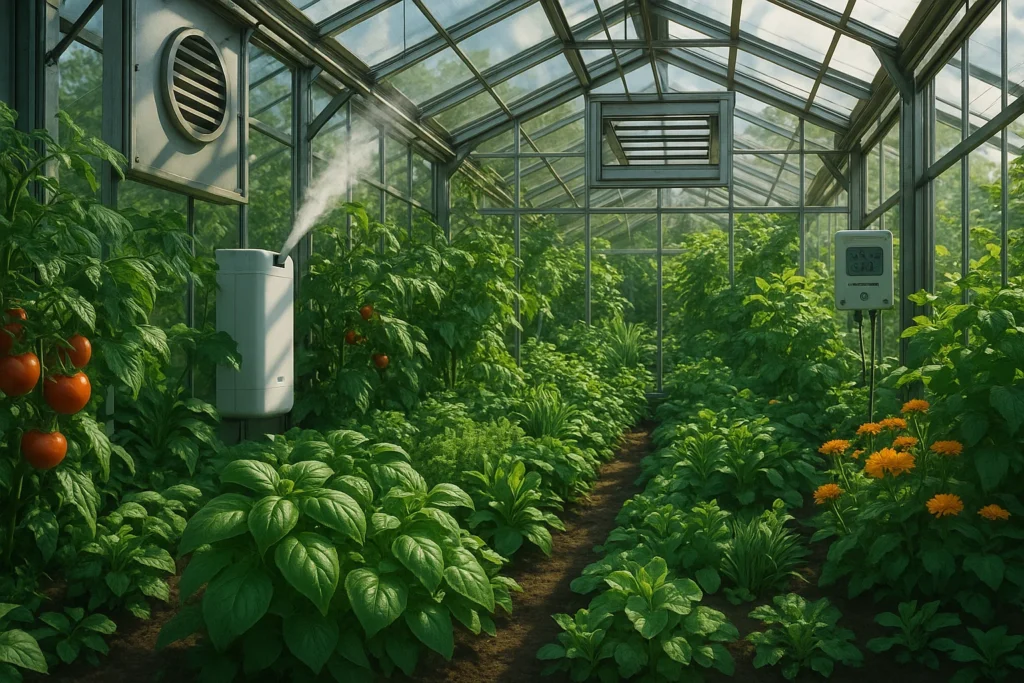
Humidity monitoring equipment provides essential data for effective environmental management. Digital hygrometers with min/max memory functions track humidity fluctuations over time, revealing patterns that help optimize growing conditions. Wireless sensor networks allow remote monitoring of multiple greenhouse zones from smartphone applications.
Dehumidification strategies remove excess moisture to prevent fungal diseases and improve plant health. Ventilation represents the most energy-efficient dehumidification method, using outside air to dilute internal humidity levels. This approach works best when external humidity levels remain below internal targets.
Heating provides effective dehumidification by increasing air’s moisture-holding capacity, reducing relative humidity levels even when absolute moisture remains constant. This technique proves particularly valuable during cool, humid periods when ventilation alone cannot maintain proper conditions.
Desiccant dehumidification uses moisture-absorbing materials to remove water vapor from greenhouse air. Commercial systems regenerate desiccant materials using waste heat, creating energy-efficient humidity control. Smaller operations can use renewable desiccant materials like calcium chloride for spot dehumidification.
Humidification becomes necessary in arid climates or during winter heating periods when relative humidity drops below optimal levels. Evaporative systems add moisture while providing cooling benefits, making them ideal for hot, dry conditions. Steam humidifiers provide precise moisture control without temperature changes.
Misting systems offer localized humidification around specific plants or growing areas. These systems use high-pressure pumps to create fine water droplets that evaporate quickly, adding humidity without wetting plant surfaces. Timing controls prevent over-humidification while maintaining consistent moisture levels.
Water feature humidification uses ponds, fountains, or wet surfaces to add moisture through natural evaporation. This passive approach requires no energy while providing gradual, consistent humidification. Gravel bed systems wetted by recirculating pumps combine humidification with thermal mass benefits.
Air circulation prevents humidity stratification and reduces disease pressure by maintaining air movement around plant surfaces. Circulation fans create gentle airflow that disperses moisture and prevents stagnant conditions where fungal spores can establish colonies. Proper fan placement ensures coverage of all growing areas.
Integrated humidity control combines multiple strategies for comprehensive moisture management. Successful systems use ventilation for general humidity control, supplemented by heating or cooling as needed for temperature management. Monitoring systems provide feedback for automated adjustments based on plant requirements.
Seasonal humidity management adapts strategies to changing external conditions. Summer operations emphasize dehumidification and air circulation, while winter periods require humidification and careful ventilation management. Spring and fall transitions require flexible systems that can adjust quickly to changing conditions.
Regional humidity challenges require specialized approaches based on local climate patterns. Coastal operations deal with persistent high humidity requiring aggressive dehumidification, while desert regions need consistent humidification systems. Humid continental climates require flexible systems handling both extremes.
Mastering greenhouse climate control requires understanding the complex interactions between temperature, humidity, and airflow while adapting strategies to regional conditions and specific crop requirements. The most successful growers invest time in understanding these relationships, creating optimized environments where plants thrive regardless of external weather conditions. This environmental mastery transforms greenhouse growing from survival-focused gardening into precision agriculture that maximizes both plant health and productivity throughout the year.