
TRUSS SYSTEMS
Analysis and Classification of Structural Truss Systems
Introduction to Truss Systems
Truss systems are structural systems that transfer loads from the superstructure to supports through direct normal forces (axial forces) acting in the members, which are connected by hinged or pinned joints. These systems are also applicable for simply-supported structures with perforated solid sections or latticed members.
Fundamental Principles of Trusses
Key characteristics:
- Members are subjected to bending moment and shear force only at the joints
- These forces result in axial forces (tension or compression) called chord forces
- Additional tension or compression may develop in members due to these chord forces
- Members forming the system and external forces must be in the same plane
- Members must be axially loaded with their axes intersecting at a single point
- External forces act only at the joints
- Angles between members should not be too small (α ≥ 30°)
Classification of Truss Systems
1. Simple Truss Systems
These are three-dimensional systems where the joints forming the system are not in the same plane.
2. Planar Truss Systems
These are systems where the joints are in the same plane. They are classified into three categories:
a. Simple Truss Systems
Basic triangulated systems with fundamental geometric configurations.
b. Composite Truss Systems
Systems formed by combining multiple simple truss systems.
c. Complex Truss Systems
Advanced systems with intricate member arrangements and loading conditions.
Classification by Geometric Configuration
A. Classification by Top Chord Configuration
Parallel Chord Systems
Non-Parallel Chord Systems
B. Classification by Web Member Configuration
Web Member Patterns
- N-System: Diagonal members oriented in one direction
- V-System: Diagonal members forming V patterns with alternating directions
- K-System: Complex diagonal arrangements meeting at mid-height
C. Classification by Support Location
- Top Support Trusses: Supports located at the top chord (inverted trusses)
- Bottom Support Trusses: Supports located at the bottom chord (standard configuration)
Structural Analysis Requirements
Truss Analysis Conditions
Key Analysis Principles
In trusses, members are subjected to bending moments and shear forces only at the joints, resulting in zero or normal forces in the members themselves.
These are called chord forces. Truss systems provide greater stability for the overall structure due to their isostatic nature. Work performed at the same level with solid cross-section members combined with three interconnected rods demonstrates the fundamental stability condition in planar truss systems.
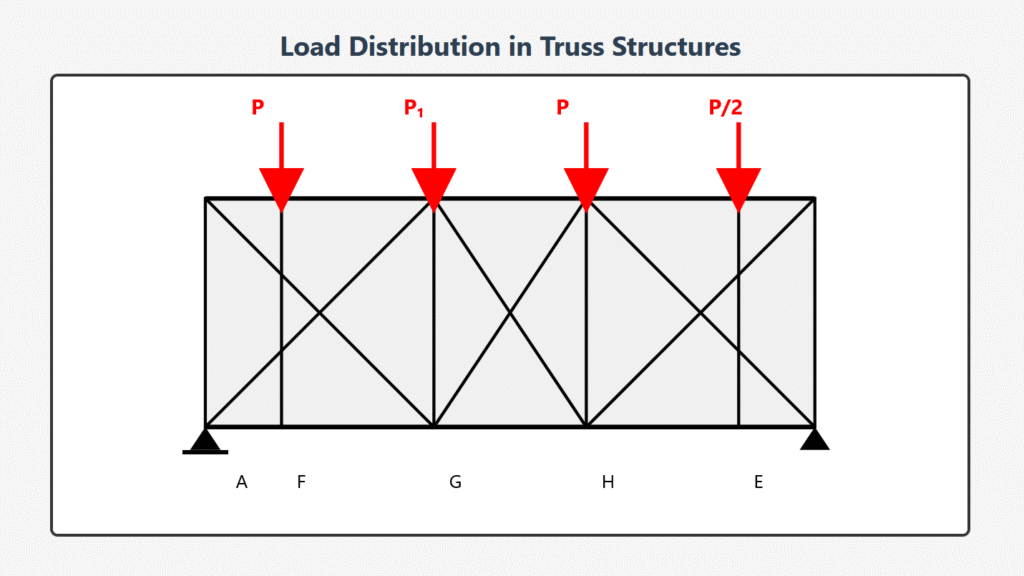
Load Distribution in Truss Structures
Static Determinacy Conditions
A. External Static Determinacy
External determinacy requires the support system to be in equilibrium
- Supports must provide exactly three reaction components for planar structures
- Support arrangement must prevent rigid body motion
- Reactions must be uniquely determinable from equilibrium equations
B. Internal Static Determinacy
Number of joints × 2 = Number of members + 3
Or equivalently:
m = 2n – 3
Where:
m = number of members (bars)
n = number of joints (nodes)
- If m = 2n – 3 → Statically determinate structure
- If m < 2n - 3 → Unstable structure (mechanism)
- If m > 2n – 3 → Statically indeterminate structure
Loading on Roof Trusses
Types of Loads Acting on Roof Trusses
| Load Type | Description | Formula |
|---|---|---|
| 1. Snow Load (Pk) | Snow accumulation on roof surface | Pk = 75 + 0.08(H – 1000) kg/m² For H ≤ 1000m: 75 kg/m² |
| 2. Wind Load (PR) | Wind pressure on roof surface | PR = 150 × (Sin α)² kg/m² |
| 3. Roof Covering Load (PÇÖ) | Weight of roofing materials and decking | PÇÖ varies by material type kg/m² |
| 4. Truss Self-Weight (PMA) | Dead load of truss members | PMA varies by span and member sizes |
- H = Altitude above sea level (m)
- α = Roof slope angle
- Wk = Snow load × tributary area (Sr)
- WR = Wind load × tributary area (Sr)
- WÇÖ = Roof covering load × tributary area (Sf)
- Sr = Horizontal projection area (tributary width)
- Sf = Actual sloped area
Total Load Calculation
ΣPMA = Wk + WR + WÇÖ + WMA
Where all loads are converted to concentrated forces at truss joints
Load Combination Principles
Roof trusses must be designed for various load combinations including:
- Dead load + Live load (Snow)
- Dead load + Wind load
- Dead load + Snow load + partial Wind load
Design codes specify which combinations to use and appropriate safety factors for each case.
Summary of Key Concepts
- Member Forces: All members carry only axial forces (tension or compression)
- Joint Conditions: Members are connected by frictionless pins (theoretical assumption)
- Load Application: All external loads applied at joints only
- Geometric Stability: Proper triangulation ensures structural stability
- Static Determinacy: m = 2n – 3 for statically determinate planar trusses
- Angle Requirements: Member angles should be ≥ 30° for efficient load transfer
- Classification: Trusses classified by chord configuration, web pattern, and support location
Practical Applications
Truss systems are widely used in:
- Bridge structures (especially for medium to long spans)
- Roof structures for industrial and commercial buildings
- Transmission towers and communication structures
- Temporary support structures and scaffolding
- Cranes and lifting equipment