
Statics – Method of Joints Analysis
TRUSS MEMBER FORCE CALCULATION
Complete Analysis Using Method of Joints
METHODS FOR CALCULATING TRUSS MEMBER FORCES
A. Method of Joints – Analyzes equilibrium at each joint/node
B. Method of Sections (Ritter Method) – Analyzes equilibrium of cut sections
This tutorial focuses on the Method of Joints approach
METHOD OF JOINTS – Theory and Procedure
Fundamental Principles
- Start from the simplest joint: Begin analysis at a joint with the fewest unknowns (ideally 2 unknown forces)
- External forces affect joints: Support reactions, external loads (roof loads, etc.) act as forces at the joints, and forces are transmitted through members connecting to those joints
- Member force assumptions: When analyzing the joint where members are connected, if the sign of the member force is unknown, assume the member is in tension or compression. The result of the calculation determines the actual state:
- Positive (+) result → Member is in TENSION (pulling away from joint)
- Negative (-) result → Member is in COMPRESSION (pushing into joint)
- Equilibrium equations: At each joint in the analysis, all external forces and unknown member forces must satisfy equilibrium:
- ΣFx = 0 (Sum of horizontal forces = 0)
- ΣFy = 0 (Sum of vertical forces = 0)
Sign Convention for Member Forces
TENSION (+)
Member pulls away from joint
COMPRESSION (-)
Member pushes into joint
EXAMPLE PROBLEM
Problem Statement
Calculate the member forces in the truss shown below using the Method of Joints.
Truss Structure and Loading
Given Data:
- Total applied loads: 4P = (6 + 12 + 12 + 12 + 6) = 48 kN
- Support reactions (by symmetry): Ay = Ey = 48/2 = 24 kN
- Panel width: 3 m each
- Geometry: tan(α) = 2/3 → α = 26.57°
SOLUTION – Joint by Joint Analysis
Joint A
Analysis of Joint A
ΣFx = 0:
FAB cos(26.57°) + FAF = 0
0.894 FAB + FAF = 0
ΣFy = 0:
Ay – 6 + FAB sin(26.57°) = 0
24 – 6 + 0.447 FAB = 0
18 + 0.447 FAB = 0
FAB = -40.27 kN
From ΣFx = 0:
0.894(-40.27) + FAF = 0
FAF = 36.0 kN
FAB cos(26.57°) + FAF = 0
0.894 FAB + FAF = 0
ΣFy = 0:
Ay – 6 + FAB sin(26.57°) = 0
24 – 6 + 0.447 FAB = 0
18 + 0.447 FAB = 0
FAB = -40.27 kN
From ΣFx = 0:
0.894(-40.27) + FAF = 0
FAF = 36.0 kN
Joint A Results: FAB = -40.27 kN (COMPRESSION), FAF = +36.0 kN (TENSION)
Joint F
Analysis of Joint F
ΣFx = 0:
-FAF + FFG = 0
-36.0 + FFG = 0
FFG = 36.0 kN
ΣFy = 0:
(Automatically satisfied, no vertical components)
-FAF + FFG = 0
-36.0 + FFG = 0
FFG = 36.0 kN
ΣFy = 0:
(Automatically satisfied, no vertical components)
Note: Since there are no vertical forces or inclined members at joint F, FFG must equal FAF for horizontal equilibrium.
Joint F Result: FFG = +36.0 kN (TENSION)
Joint B
Analysis of Joint B
ΣFx = 0:
-FBA cos(26.57°) + FBC cos(26.57°) = 0
-(-40.27) × 0.894 + FBC × 0.894 = 0
36.0 + 0.894 FBC = 0
FBC = -40.27 kN
ΣFy = 0:
-12 + FBA sin(26.57°) + FBC sin(26.57°) – FBF = 0
-12 + (-40.27)(0.447) + (-40.27)(0.447) – FBF = 0
-12 – 18 – 18 – FBF = 0
FBF = -48 kN
-FBA cos(26.57°) + FBC cos(26.57°) = 0
-(-40.27) × 0.894 + FBC × 0.894 = 0
36.0 + 0.894 FBC = 0
FBC = -40.27 kN
ΣFy = 0:
-12 + FBA sin(26.57°) + FBC sin(26.57°) – FBF = 0
-12 + (-40.27)(0.447) + (-40.27)(0.447) – FBF = 0
-12 – 18 – 18 – FBF = 0
FBF = -48 kN
Joint B Results: FBC = -40.27 kN (COMPRESSION), FBF = -48 kN (COMPRESSION)
Joint C
Analysis of Joint C (Peak)
By symmetry: FCD = FCB = -40.27 kN
ΣFy = 0:
-12 + FCB sin(26.57°) + FCD sin(26.57°) – FCG = 0
-12 + (-40.27)(0.447) + (-40.27)(0.447) – FCG = 0
-12 – 18 – 18 – FCG = 0
FCG = -48 kN
ΣFy = 0:
-12 + FCB sin(26.57°) + FCD sin(26.57°) – FCG = 0
-12 + (-40.27)(0.447) + (-40.27)(0.447) – FCG = 0
-12 – 18 – 18 – FCG = 0
FCG = -48 kN
Note: Due to symmetry about the centerline, joints D, H, and E will have identical force patterns to joints B, F, and A respectively.
Joint C Results: FCD = -40.27 kN (COMPRESSION), FCG = -48 kN (COMPRESSION)
Completing the Analysis
Due to the symmetric loading and geometry, the remaining joints (D, H, E) have identical force distributions to their mirror counterparts (B, F, A):
- Joint D mirrors Joint B
- Joint H mirrors Joint F
- Joint E mirrors Joint A
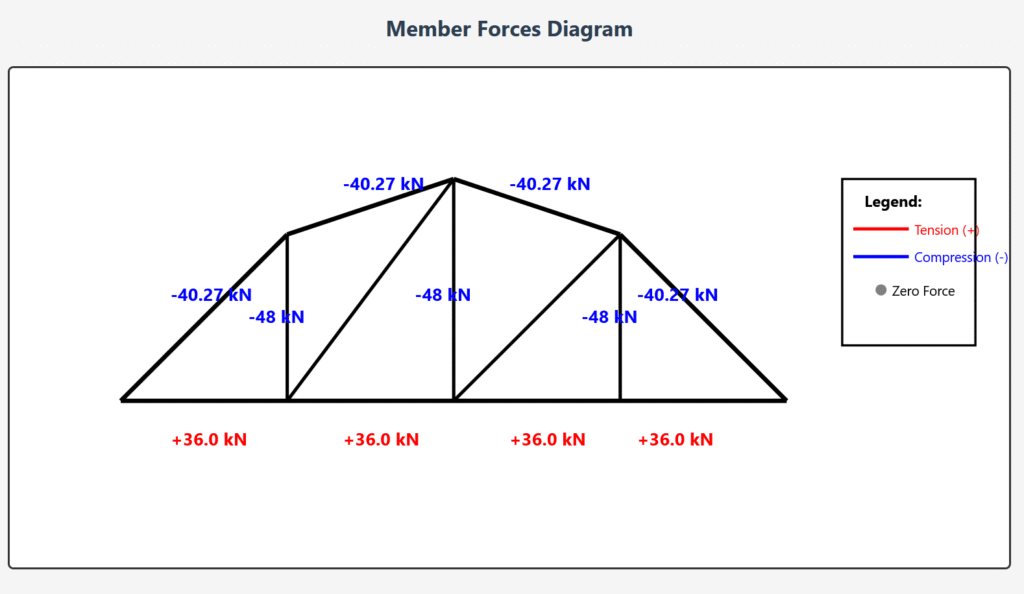
COMPLETE RESULTS SUMMARY
| Member | Force (kN) | Type | Notes |
|---|---|---|---|
| AB, DE | -40.27 | Compression | Inclined top chord members |
| BC, CD | -40.27 | Compression | Inclined top chord members |
| AF, EH | +36.0 | Tension | Bottom chord members |
| FG, GH | +36.0 | Tension | Bottom chord members |
| BF, DH | -48.0 | Compression | Vertical members |
| CG | -48.0 | Compression | Center vertical member |
| BG, DG | 0 | Zero-force | Diagonal members (zero-force members) |
Member Forces Diagram
SUMMARY OF MEMBER FORCES
COMPRESSION MEMBERS:
Top Chord: AB, BC, CD, DE = -40.27 kN
Verticals: BF, CG, DH = -48.0 kN
TENSION MEMBERS:
Bottom Chord: AF, FG, GH, HE = +36.0 kN
All equilibrium equations satisfied ✓
Key Observations and Learning Points
- Systematic Approach: Always start from joints with the fewest unknowns (typically 2)
- Sign Convention Consistency: Negative values indicate compression, positive indicate tension
- Symmetry Advantage: Recognize symmetric structures to reduce calculation effort
- Force Patterns: Top chords typically in compression, bottom chords in tension for downward loads
- Vertical Members: Usually in compression when loads act downward
- Equilibrium Check: Each joint must satisfy ΣFx = 0 and ΣFy = 0
- Member Design: Compression members need to be checked for buckling, tension members for yielding
Important Design Considerations:
- Compression Members: Maximum force is 48 kN – must check buckling capacity based on length and cross-section
- Tension Members: Maximum force is 36 kN – must check tensile yielding and net section capacity at connections
- Connections: Joint design must accommodate maximum forces from all connecting members
- Load Combinations: This analysis is for one load case – check multiple load combinations per code
- Member Lengths: Diagonal members are longer (√(2²+3²) = 3.61 m) than horizontal members (3 m)