
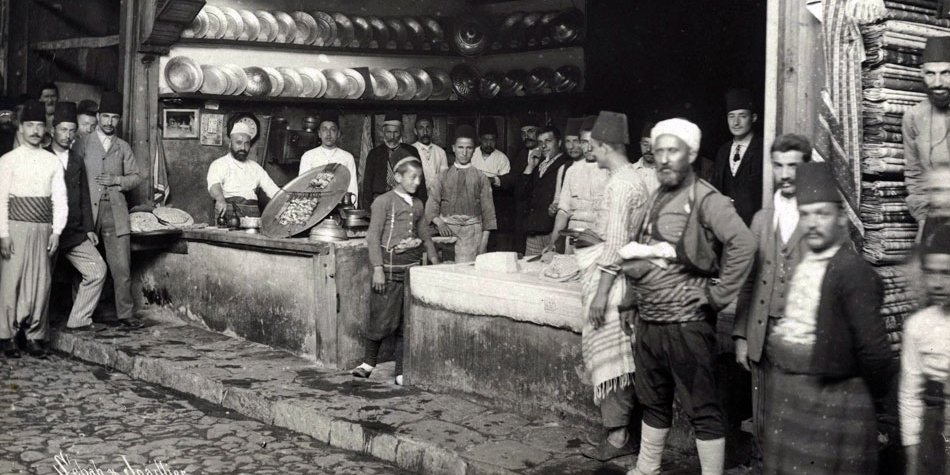
Cabi Efendi, unlike other elderly men, did not spend his days idling at home from morning till night. True, he never lifted a finger for any serious work either, saying, “I have food to eat, drink to drink! What do I need work for?” But every morning, before the sun rose, he would throw himself into the street.
His sole passion was to inquire about “the state of the world.” He belonged to the “literate” class. Yet he never made use of this virtue. Whenever he passed by libraries, he couldn’t help himself: “Behold, the granary of ignorance!” he would smile. In his view, books were nothing but elegant, ornate, precious bricks haphazardly piled upon ‘truth.’ Anyone who didn’t gather these bricks and cast them aside could never, by any means, see reality.
Truth was not in books, but in life itself. Those who believed in books became enslaved, their minds calcified, their heads turned to brick. Whereas only… Life—ever-changing, fitting into no concept’s narrow frame—was worth reading. In every step of life lay hidden thousands of oddities, thousands of secrets, thousands of intrigues. Science, wisdom, culture, philosophy, knowledge—all were within life itself. For instance, this Istanbul, which he couldn’t finish exploring in fifty years, was an enormous book of over a million pages. Every person wandering its streets, bazaars, and markets was a separate world unto himself, a separate book. To attempt reading all these books was as impossible as drinking the ocean; yet a person who could glean even a section of just one would undoubtedly be among the greatest possessors of knowledge. Cabi Efendi, who took pride in never touching a single brick—sacred or otherwise—since receiving his diploma from the neighborhood school, was indeed one of these sages who read only life! He was considered by all the neighborhood folk to be the world’s foremost scholar. With his white spherical beard, short stature, and portly frame, he could be seen rolling about in the most unexpected places; he would catch hold of anyone, caress them with his tiny plump hands while dispensing advice, and allow everyone, young and old alike, to benefit from his learning and wisdom. Like books, he didn’t read newspapers either. He claimed that these scraps of paper, which he called “money traps,” were filled with lies from beginning to end: “I don’t believe in anything I haven’t seen with my own eyes!” he would say. He had believed in bicycles, gramophones, cinema, telephones, automobiles, airplanes, and submarines only after seeing them with his own eyes.
… Once more, on a spring morning, as the sun rose over the jujube trees from bygone times in his garden, Cabi Efendi appeared at his door. He walked a few steps and stopped. He looked around. Grass had sprouted on the ground, and scrawny plum branches were covered with pink and white blossoms. He was pleased. He raised his crooked nose to the left and upward. He sniffed the air deeply. “What grace, what beauty, O Lord!” he murmured.
God must surely have created spring to make His servants love the world! Every year, spring appeared to people weary of winter, rain, mud, snow, cold, and blizzards like a fairy bride from a dream, scattering “consolation, warmth, and hope” upon their sluggish souls, then slipping away with its butterflies, flowers, and fragrances, leaving them “unawares” in the inferno of summer… “But I won’t be fooled!” he said. “It’s all a dream… A few weeks from now, neither these flowers nor these scents will leave a trace!”
He deliberately crushed with his feet the brilliant diamond drops of dew on the grass, fallen from the sun. The moment he stepped into the street, his eye caught the sparrows chirping as they pecked at what the vegetable seller’s and milkman’s horses had left on the broken pavement during the night. He didn’t stop. “One’s filth is another’s blessing…” he said. Against his own will, his mind tried to extract wisdom from this ugly incident. Reluctantly, he recalled bees and humans. The “event” was the same. Yet there was a discrepancy in the dimensions of the parties involved in the event. In one, the producer was small, the consumer large. In the other, the reverse; the producer large, the consumer small…
He walked on. Now where would he go? He always decided this after setting out. He considered going to Çırpıcı, Veliefendi, Balıklı, Eyüp, or Sütlüce. No… From behind the wall whose shadow he walked in came a sharp rooster’s crow. Cabi Efendi immediately raised his head to the sky. He looked carefully. There wasn’t a cloud in sight. The weather was very clear.
“One mustn’t trust roosters anymore either,” he said. “What can you expect? They give forty hens to a single rooster. The poor creatures’ nerves are shot. They don’t know why or when they’re crowing.”
He stopped and scratched his beard. The weather didn’t look like it would turn bad at all. Where would he spend this beautiful day? How long had it been since he’d crossed over to Üsküdar?
“I’ll stop by the dervish lodges too,” he said. Again, he walked on, rolling along. He reached the avenue. He jumped onto the Topkapı tram. Inside, it was packed with foundation and customs officials and the like. First, he eavesdropped on them. They were all talking nonsense, even jostling and joking with each other.
Cabi Efendi closed his eyes to avoid seeing these shameless behaviors. He became so annoyed that he almost said, “My God, why didn’t you make lids for ears too?”
In Sirkeci, he opened his eyes with an “Oh!” and slowly crossed the Bridge, for which he paid his toll, right in the heart of the city. He bought a ticket for the Üsküdar ferry. He went up to the deck. The weather was truly, very beautiful indeed. Flocks of clean, white seagulls passed through the pitch-black smoke from the funnel without getting soiled, and in the middle of the dark blue sea, the “Maiden’s Tower” gleamed like a flame of foam.
Cabi Efendi thought that despite traveling around Istanbul every day for fifty years, he still hadn’t been there. What was it like inside, he wondered? Who had it built? What was in it now? When it was built, didn’t the southwesterly winds blow in Istanbul? Many more such questions assaulted his preoccupied mind. “I’ll go there today. I’ll learn the truth…” he said.
Until the ferry docked at the landing, he made his travel plans. He would come by land to the Harem landing, and from there take a rowboat to the Maiden’s Tower. But absentmindedly, while passing through the street going from Ahmediye to Karlık Hill, something strange caught his eye. He stopped. He immediately forgot all about the Maiden’s Tower and such. He looked, and looked, and looked:
“This can’t be!” he said.
A somewhat dark, clean, spacious carpenter’s shop… Inside, a comfortable-looking man in his forties with a thick black mustache, rather plump… He held an adze and was working; but in front of a large, delicate counter made of white marble! Cabi Efendi rubbed his eyes, thinking “I mustn’t be deceived!” He looked carefully. No. The counter was marble! The suspicion “Could it be tin plated white?” clouded his mind again. He looked. He looked again. Could there ever be a carpenter’s, a joiner’s counter made of marble? If so… There must surely be a special reason for this! Cabi Efendi thought that marble was more expensive than tin plate.
He scratched his head and beard. No doubt about it, this place must have formerly been either a boza shop or a pudding shop. This carpenter who came later must have found the marble counter already there. He laughed. “Lazy fellow!” he said. “Who knows how many adzes he’s ruined. Who works on marble?” Suddenly he felt his advice-giving veins swelling. Everything had its method, its rule. Those who violated methods and rules were certain to suffer harm. He didn’t hesitate. Involuntarily, he entered through the shop’s open door. He asked the carpenter, who looked at him as if to say “What do you want?”:
“You just recently rented this shop, didn’t you?”
When he received the answer “No,” he asked again:
“Rent it whenever you like. But before you, a pudding seller sat here, didn’t he?”
“No.”
“Then a boza seller?”
“No.”
“Then who sat here?”
“No one… I had this shop built myself.”
“Well, what’s this marble counter doing here?”
“I had it installed.”
Cabi Efendi’s eyes widened. He looked at the carpenter with even sharper attention:
“Are you mad, son?” he said.
“No.”
“Would a sensible man wield an adze on marble?”
“Why shouldn’t he?”
“The adze might slip by accident. Both the marble would be ruined and the adze…”
“I never let my adze slip.”
“How many years have you been a carpenter?”
“Twenty years.”
“How many years have you been working on a marble counter?”
“Fifteen years now…”
Cabi Efendi approached the counter. The carpenter was smiling, his plump cheeks above his thick mustache reddening like apples.
“In fifteen years you’ve never accidentally let your adze slip?”
“I haven’t.”
“By chance… Not even once…”
“Not even once. If you like, come, look…”
Cabi Efendi took his glasses from his pocket. He put them on. He looked. He looked again. There wasn’t even a faint scratch on the surface of the shining marble counter. Then he turned to the carpenter. He examined him thoroughly from head to toe. He didn’t look like such an intelligent man at all. He asked again:
“Until now you’ve never struck wrong with your adze?”
“You see for yourself…”
“How is this possible?”
“Because I’m a first-class master craftsman. I see clearly where I’ll strike. I never err. I trust in my hand’s skill, that’s why I had the counter made of marble.”
Cabi Efendi couldn’t contain himself:
“Son, this isn’t from the skill in your hand,” he said.
“Then why?”
“From your thoughtlessness…”
“From my thoughtlessness?”
“Yes.”
The carpenter’s thick, black eyebrows furrowed. He gently placed his adze on the marble counter. He scowled. In a manner bordering on insult, he asked Cabi Efendi:
“Where did you get that from?”
“Where would I get it from? If you had any thought, you couldn’t use your adze this carefully all the time.”
“How do you know I have no thought? Whatever the case, I know where to bring down my adze. I never falter. I am ‘a master of my craft.’ Come on now, enough chatter… Get along with your business…”
…
Cabi Efendi became thoroughly upset. While he had been speaking pleasantly with him, upon hearing the truths, the fellow’s sudden change and turn to rudeness thoroughly annoyed him. Without time to remove his glasses, he left the shop looking glumly ahead.
“Master of your craft, eh… You fool, you,” he gritted his teeth. He shook his head. Seeking the cause of every incident was a compulsion in him. Getting the parties involved in the events themselves to see and accept the cause he found was another compulsion. Here was this fool, attributing his ‘infallible attention’—which was the result of his thoughtlessness—to the skill of his hand, considering his thoughtlessness a ‘virtue’ for himself. He turned back swiftly. He shouted from the door to the indifferent carpenter who had started his work:
“Master, watch out tomorrow! You won’t be able to place your adze exactly right. You’ll break your marble counter…”
…
He didn’t wait for an answer. He walked away immediately. He turned into the opposite street. He entered the nearby shops one by one. He gathered much information about the carpenter with the marble counter. He learned that his name was the famous Ali Usta. He apparently lived in the single-story, red ochre-painted house number seven adjacent to the Old Valide garden. He had recently married. He had a young wife… All his neighbors were unanimous in praising the skill of his hands. “He’s never driven a wrong nail in his life. He trusts his adze. There’s no equal to him in Istanbul. Not even in Europe is there a carpenter who works on a marble counter like him,” they said.
To all of them, Cabi Efendi inwardly thought, “Tomorrow you’ll see his marble counter,” while outwardly he nodded his head saying, “True, true…” There was still plenty of time until noon. Thinking over and over about the plan he had devised to make Ali Usta break his marble counter, he entered the courtyard of the New Mosque.
Making this thoughtless fellow think for just a moment would be enough! Cabi Efendi had much experience. He knew as surely as his faith that the tiniest thought could bankrupt the greatest attention. By repeating one of these experiences on this thoughtless fellow, he would force him too to accept this truth. Once he completed his plan in his mind, he entered the butcher shop across from the mosque courtyard. He bought one of the slaughtered, skinned lambs. He gave it to the apprentice’s hand. He went over to the Russian’s bakery. He asked how many hours it would take to roast a lamb.
When he received the answer “Two hours…” he immediately had them get a large earthenware pot as well. He had the lamb thrown into the oven. He himself leaned against the shop’s dirty shutter. He filled his short pipe. He lit it. For a full two hours there, he watched the smoke from his pipe without making a sound, like a stone of patience. When the lamb was cooked, he found a porter. He gave the pot into his hand. He went ahead. He climbed the slope leading to Çavuş Creek. He found the Old Valide garden. When he saw the single-story, red ochre-painted house adjacent to the garden:
“Ah, here it is,” he said and walked on. He knocked on the door knocker. From inside, a thin, shrewish woman’s voice said:
“Who’s that, let me see, who’s that?”
“Me.”
“Who are you, for heaven’s sake?”
“Isn’t this the house of the famous carpenter Ali Usta with the marble counter?”
“Yes.”
“The master roasted this lamb. He sent it. Take it.”
The door opened halfway. Two thick, white, bare arms took the lamb pot inside with white hands. As if angered by some unknown thing, she slammed the door shut. Cabi Efendi smiled:
“Tomorrow the marble counter…”
He rubbed his hands together. His eyes caught the faded number above the low door, whose wind had struck his face like a tremendous slap that had missed its mark:
“Seven, seven,” he nodded his head. Early in the morning he would see that the marble counter had been broken. For this reason, he didn’t cross over to Istanbul. He went straight to Hacı Hüseyin’s inn at the Horse Market. He rented a clean room. He would spend the night in Üsküdar.
…
It was the habit of the famous carpenter Ali Usta to come home late. Upon entering the door, he would sit straight down at the table. This evening, when he settled at the head of the table, he was surprised. He said to his wife:
“What’s this then? Where did this lamb come from?”
“I should ask you!”
“What do you mean?”
“You sent it today.”
“God forbid…”
“God forbid?”
“!..”
His wife was the stepdaughter of the late former Kasımpaşa imam. She would get angry very quickly. She turned bright red again. She put her hands on her hips. She twisted her face:
“God forbid, eh?”
“…”
“So, you’re saying I stole this?”
“I don’t know.”
“Did a friend send it?”
“I can’t know that either!”
“You sent it during the day. Now you’ve forgotten and are making a fuss?”
Ali Usta said:
“I never forget anything.”
“Get out of here, you senile man… I was doing laundry. A man came. He said, ‘Is this the house of Ali Usta with the marble counter?’ I said, ‘Yes.’ He said, ‘He sent this lamb with me.’ So I took it.”
“What kind of man was he?”
“You think I look at strange men, eh… I didn’t even see him.”
“What was his voice like?”
“You think I listen to the voice of strange men, eh… I swear I didn’t hear it.”
“?..”
“!..”
The husband and wife had a good fight over this lamb. Ali Usta couldn’t put a single morsel in his mouth, not from this exquisite lamb, nor even from the other dishes. Who could have sent this lamb? He was bursting with curiosity. Could it be some spell to destroy his home and hearth? He couldn’t drink his coffee or smoke his pipe either. For the first time in his life, he lost sleep that night. He couldn’t sleep until morning. His wife was still accusing him of forgetfulness, saying, “You’ve gone senile, for heaven’s sake, go have yourself read over at Pabucu Büyük.”
He went down to his shop without performing the morning prayer. He opened the shutters. He was so distracted that he didn’t even see Cabi Efendi watching him from the corner. With mechanical silence, he took his adze in his hand. He placed the work left over from yesterday on the marble counter. From the open door, Cabi Efendi smiled, watching his distraction. The poor fellow’s mind and thoughts were all on last night’s lamb. “Who sent it, O Lord, who sent it, who could it be?” he was thinking. When he brought down the sharp, thick, heavy adze he had raised, his eyes opened wide.
A piece of marble the size of a hand had broken off from the counter and flew to the floor. At the same time, he heard a voice from the door behind him:
“My condolences, master!”
“?..”
He turned. When he saw the little old man he had driven away yesterday, he was utterly astonished. Cabi Efendi asked:
“What about being a master of your craft! What happened?”
“!..”
Poor Ali Usta couldn’t open his mouth. He turned pale as death. His lips were trembling. At that moment, Cabi Efendi pitied this man who until now had considered his attention—which was the result of thoughtlessness—a virtue in himself.
“Don’t think anymore,” he said; “I sent that lamb.”
“You?”
“Yes.”
“Why?”
“To make you think a little…”
Then he didn’t spare the effort, and standing right there, explained at length how man is “a thinking animal,” how distraction sometimes causes one to lose the quality of attention, and how “infallible, sharp attention” should be considered a trait belonging solely to “thoughtless animals.”
As he left through the door, he said:
“Come on, son, don’t try to upset the order of the world. A carpenter’s counter is made of tin plate. Now remove this marble you’ve broken immediately. Put a wooden counter in its place!”
…
An hour later, Cabi Efendi was boarding a shabby rowboat swaying in the dark navy blue waves of Harem landing. He would discover why the Maiden’s Tower, which he had decided to visit yesterday, was built in the middle of the sea, and he would surely find the real reason for that too! But he was so pleased that this morning, early on, he had been able to teach an ignorant man ‘the truth of attention’…