
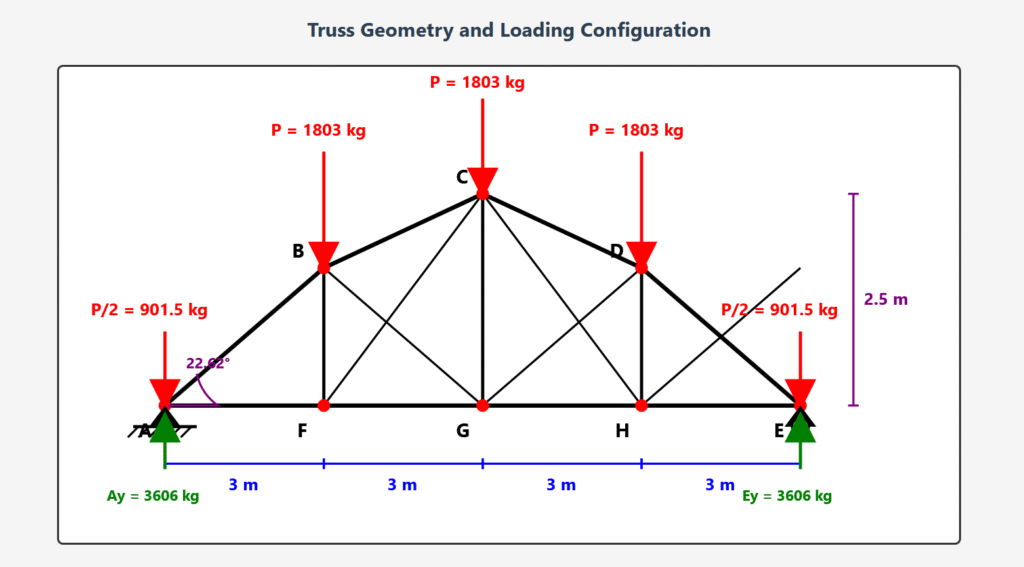
Statics – Worked Example
ROOF TRUSS ANALYSIS
Complete Load Calculation and Support Reaction Analysis
PROBLEM STATEMENT
Calculate the joint loads and support reactions for a roof truss structure at the support points according to the given data:
- Altitude: 900 m above sea level
- Truss Spacing: 5.0 m
- Structure Self-Weight: 10 kg/m²
- Roof Covering Load: 12 kg/m²
- Total Span: 12 m (divided into 4 panels of 3 m each)
- Peak Height: 2.5 m above bottom chord
Truss Geometry and Loading Configuration
Given Data Summary
| Parameter | Symbol | Value |
|---|---|---|
| Altitude | H | 900 m |
| Truss Spacing | – | 5.0 m |
| Structure Self-Weight | PMA | 10 kg/m² |
| Roof Covering Load | PÇÖ | 12 kg/m² |
| Panel Width | – | 3.0 m |
| Total Span | L | 12 m |
| Peak Height | CG | 2.5 m |
| Half Span | GE | 6.0 m |
SOLUTION – Complete Step by Step Analysis
Step 1
Calculate Roof Slope Angle
Using trigonometry for the roof slope:
tan(α) = CG / GE
tan(α) = 2.5 / 6.0
tan(α) = 0.4167
α = arctan(0.4167) = 22.62°
tan(α) = CG / GE
tan(α) = 2.5 / 6.0
tan(α) = 0.4167
α = arctan(0.4167) = 22.62°
Roof Slope Angle: α = 22.62°
Understanding the geometry: The roof rises 2.5 m over a horizontal distance of 6.0 m (half the span), giving us the slope angle. This angle is crucial for calculating wind loads and determining the sloped length of the roof members.
Step 2
Calculate Sloped Length (CE)
Using Pythagorean theorem:
CE² = CG² + GE²
CE² = 2.5² + 6.0²
CE² = 6.25 + 36
CE² = 42.25
CE = √42.25 = 6.5 m
CE² = CG² + GE²
CE² = 2.5² + 6.0²
CE² = 6.25 + 36
CE² = 42.25
CE = √42.25 = 6.5 m
Total Sloped Length from Peak to Support: CE = 6.5 m
Verification: We can verify this using: CE = GE / cos(α) = 6.0 / cos(22.62°) = 6.0 / 0.923 = 6.5 m ✓
Step 3
Calculate Sloped Length per Panel (CD or DE)
Each panel sloped length:
CD = DE = CE / 2
CD = DE = 6.5 / 2
CD = DE = 3.25 m
CD = DE = CE / 2
CD = DE = 6.5 / 2
CD = DE = 3.25 m
Sloped Length per Panel: 3.25 m
Step 4
Calculate Tributary Areas
S1 – Sloped Area (for roof covering):
S1 = Sloped length × Truss spacing
S1 = 3.25 × 5.0
S1 = 16.25 m²
S1 = Sloped length × Truss spacing
S1 = 3.25 × 5.0
S1 = 16.25 m²
S2 – Horizontal Projection Area (for vertical loads):
S2 = Panel width × Truss spacing
S2 = 3.0 × 5.0
S2 = 15.0 m²
S2 = Panel width × Truss spacing
S2 = 3.0 × 5.0
S2 = 15.0 m²
Tributary Areas: S1 = 16.25 m² (sloped), S2 = 15.0 m² (horizontal)
Key Concept:
- S1 is used for loads applied perpendicular to the roof surface (roof covering, roofing materials)
- S2 is used for loads acting vertically downward (snow, self-weight of structure)
Step 5
Calculate Snow Load (Pk)
Snow load formula (altitude-dependent):
Pk = 75 + 0.08(H – 1000) kg/m²
For H = 900 m (below 1000 m):
Pk = 75 + 0.08(900 – 1000)
Pk = 75 + 0.08(-100)
Pk = 75 – 8
Pk = 75 kg/m²
Pk = 75 + 0.08(H – 1000) kg/m²
For H = 900 m (below 1000 m):
Pk = 75 + 0.08(900 – 1000)
Pk = 75 + 0.08(-100)
Pk = 75 – 8
Pk = 75 kg/m²
Snow Load Intensity: Pk = 75 kg/m²
Note: Since the altitude (900 m) is below the reference level of 1000 m, the snow load is actually reduced. At altitudes below 1000 m, snow loads decrease because lower elevations typically receive less snowfall.
Step 6
Calculate Total Snow Load at Joint (Wk)
Total snow load on one panel:
Wk = Pk × S2
Wk = 75 × 15.0
Wk = 1,125 kg
Wk = Pk × S2
Wk = 75 × 15.0
Wk = 1,125 kg
Snow Load at Each Interior Joint: Wk = 1,125 kg
Step 7
Calculate Wind Load (PR)
Wind load formula:
PR = 150 × (sin α)²
PR = 150 × (sin 22.62°)²
PR = 150 × (0.3846)²
PR = 150 × 0.1479
PR = 22.19 kg/m²
PR = 150 × (sin α)²
PR = 150 × (sin 22.62°)²
PR = 150 × (0.3846)²
PR = 150 × 0.1479
PR = 22.19 kg/m²
Wind Load Intensity: PR = 22.19 kg/m²
Step 8
Calculate Total Wind Load at Joint (WR)
Total wind load on one panel:
WR = PR × S2
WR = 22.19 × 15.0
WR = 332.85 kg ≈ 333 kg
WR = PR × S2
WR = 22.19 × 15.0
WR = 332.85 kg ≈ 333 kg
Wind Load at Each Interior Joint: WR = 333 kg
Step 9
Calculate Roof Covering Load (WÇÖ)
Total roof covering load on one panel:
WÇÖ = PÇÖ × S1
WÇÖ = 12 × 16.25
WÇÖ = 195 kg
WÇÖ = PÇÖ × S1
WÇÖ = 12 × 16.25
WÇÖ = 195 kg
Roof Covering Load at Each Interior Joint: WÇÖ = 195 kg
Note: Roof covering load uses the sloped area (S1) because the material (tiles, shingles, etc.) is distributed along the actual slope surface.
Step 10
Calculate Structure Self-Weight (WMA)
Total self-weight on one panel:
WMA = PMA × S2
WMA = 10 × 15.0
WMA = 150 kg
WMA = PMA × S2
WMA = 10 × 15.0
WMA = 150 kg
Structure Self-Weight at Each Interior Joint: WMA = 150 kg
Step 11
Calculate Total Load at Interior Joints
Sum of all loads:
ΣP = Wk + WR + WÇÖ + WMA
ΣP = 1,125 + 333 + 195 + 150
ΣP = 1,803 kg
ΣP = Wk + WR + WÇÖ + WMA
ΣP = 1,125 + 333 + 195 + 150
ΣP = 1,803 kg
Total Load at Each Interior Joint (B, C, D): P = 1,803 kg
Load Distribution Breakdown:
- Snow Load: 1,125 kg (62.4%)
- Wind Load: 333 kg (18.5%)
- Roof Covering: 195 kg (10.8%)
- Self-Weight: 150 kg (8.3%)
- Total: 1,803 kg (100%)
Step 12
Calculate Total Applied Load on Structure
Total load from all interior joints plus half loads at supports:
Total = (P/2 at A) + (P at B) + (P at C) + (P at D) + (P/2 at E)
Total = P/2 + P + P + P + P/2
Total = 4P
4P = 4 × 1,803
4P = 7,212 kg
Total = (P/2 at A) + (P at B) + (P at C) + (P at D) + (P/2 at E)
Total = P/2 + P + P + P + P/2
Total = 4P
4P = 4 × 1,803
4P = 7,212 kg
Total Applied Load on Structure: 7,212 kg
Step 13
Calculate Support Reactions Using Symmetry
Due to symmetric loading and geometry:
Ay = Ey = Total Load / 2
Ay = Ey = 7,212 / 2
Ay = Ey = 3,606 kg
Ay = Ey = Total Load / 2
Ay = Ey = 7,212 / 2
Ay = Ey = 3,606 kg
Support Reactions: Ay = Ey = 3,606 kg
Equilibrium Check (ΣFy = 0):
Ay + Ey – 4P = 0
3,606 + 3,606 – 7,212 = 0 ✓
The system is in equilibrium!
Ay + Ey – 4P = 0
3,606 + 3,606 – 7,212 = 0 ✓
The system is in equilibrium!
Step 14
Verify Using Moment Equilibrium
Taking moments about point A (ΣMA = 0):
Loads act at distances: 3m (B), 6m (C), 9m (D), 12m (E support)
ΣMA = -(1803×3) – (1803×6) – (1803×9) – (901.5×12) + 12Ey
0 = -5,409 – 10,818 – 16,227 – 10,818 + 12Ey
0 = -43,272 + 12Ey
12Ey = 43,272
Ey = 3,606 kg ✓
Loads act at distances: 3m (B), 6m (C), 9m (D), 12m (E support)
ΣMA = -(1803×3) – (1803×6) – (1803×9) – (901.5×12) + 12Ey
0 = -5,409 – 10,818 – 16,227 – 10,818 + 12Ey
0 = -43,272 + 12Ey
12Ey = 43,272
Ey = 3,606 kg ✓
Moment Equilibrium Verified: Ey = 3,606 kg
Verification Complete:
- Force equilibrium: ΣFy = 0 ✓
- Moment equilibrium: ΣMA = 0 ✓
- Reactions: Ay = Ey = 3,606 kg ✓
Complete Results Summary
| Description | Symbol | Calculated Value |
|---|---|---|
| Roof Slope Angle | α | 22.62° |
| Total Sloped Length | CE | 6.5 m |
| Panel Sloped Length | CD = DE | 3.25 m |
| Sloped Tributary Area | S1 | 16.25 m² |
| Horizontal Tributary Area | S2 | 15.0 m² |
| Snow Load Intensity | Pk | 75 kg/m² |
| Wind Load Intensity | PR | 22.19 kg/m² |
| Total Snow Load | Wk | 1,125 kg |
| Total Wind Load | WR | 333 kg |
| Total Roof Covering Load | WÇÖ | 195 kg |
| Total Self-Weight | WMA | 150 kg |
| Load at Interior Joints (B, C, D) | P | 1,803 kg |
| Load at Support Joints (A, E) | P/2 | 901.5 kg |
| Total Applied Load | 4P | 7,212 kg |
| Support Reaction at A | Ay | 3,606 kg |
| Support Reaction at E | Ey | 3,606 kg |
FINAL ANSWER
Joint Loads:
Interior Joints (B, C, D): P = 1,803 kg
Support Joints (A, E): P/2 = 901.5 kg
Support Reactions:
Ay = Ey = 3,606 kg
(Verified by both force and moment equilibrium)
Key Learning Points
- Geometric Analysis First: Always determine roof geometry (angle, sloped lengths) before load calculations
- Two Tributary Areas: Use sloped area for surface loads, horizontal area for vertical loads
- Altitude Effect: Snow loads decrease below 1000 m (by 0.08 kg/m² per meter) and increase above 1000 m
- Wind Load Formula: Proportional to sin²(α), meaning angle significantly affects wind pressure
- Load Superposition: Total load is the sum of all individual load components
- Half Loads at Supports: End joints receive half the load of interior joints due to tributary area
- Symmetry Advantage: Symmetric structures have equal reactions, simplifying analysis
- Equilibrium Verification: Always check both force and moment equilibrium to validate results
Important Design Considerations:
- These are unfactored service loads. Apply load factors (typically 1.2 for dead, 1.6 for live) for ultimate limit state design
- Analysis assumes loads applied only at joints (standard truss assumption)
- Multiple load combinations must be checked per design codes
- Wind and snow loads typically don’t act simultaneously at full values – check code requirements
- Actual member forces in truss bars require method of joints or method of sections analysis