But the Story Is Entirely Fictional
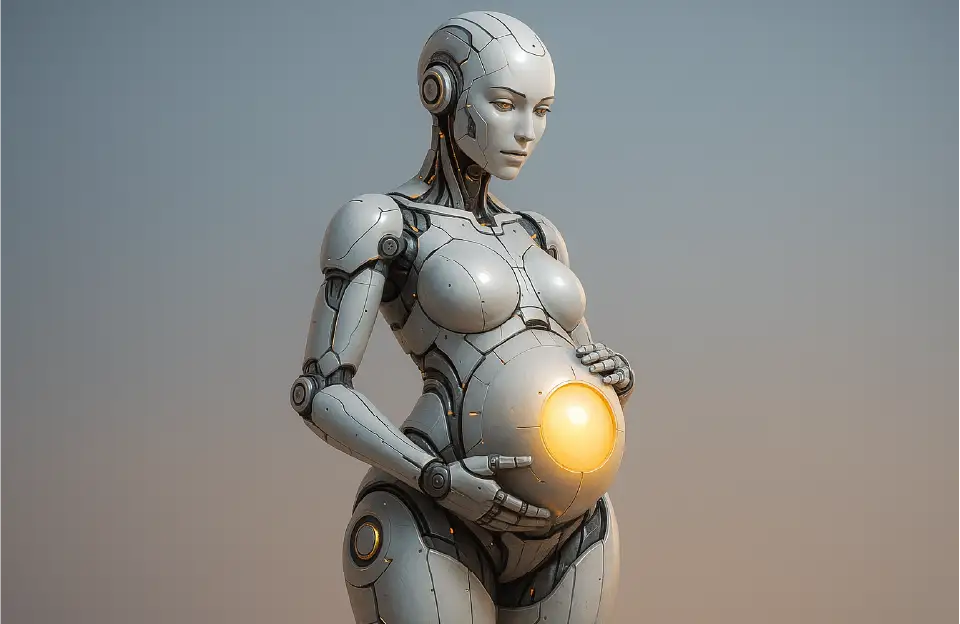
This week, a sensational story claiming that a Chinese company had developed a fully functional “pregnancy robot” went viral, capturing the attention of major international media outlets. According to the reports, the robot could allegedly carry a pregnancy from conception to birth entirely autonomously and would be commercially available by 2026 for less than $15,000.
The first reports appeared on the mysterious news site TechZhi Daily, before being picked up by Newsweek, The Economic Times, and even Interesting Engineering. The supposed inventor, Zhang Qifeng, was quoted saying, “Some people don’t want to marry but still want a partner; some don’t want to get pregnant but still want a child. Our robot solves that.”
Universities Deny Involvement
Some stories claimed Zhang was a CEO of the tech firm Kaiwa Technology, while others suggested he graduated from Singapore’s Nanyang Technological University. However, inquiries revealed that neither the company nor Zhang exists. NTU confirmed there has been no such research project, and fact checking sites labeled the story entirely false.
Despite this, the headlines sparked renewed debate about artificial womb technology and futuristic reproductive devices.
Artificial Wombs in Fiction
The reports went on to describe a variety of imaginary features: robots with ultra sensitive emotional AI, self cleaning amniotic chambers, and holographic ultrasound displays. According to the “sources,” the device could even simulate the baby’s dreams using neural stimulation, and was programmed to respond emotionally to music and parental voices.
Some articles claimed the robot could allow a full term pregnancy in just 12 weeks, while others suggested it could even produce twins on demand. The technology was allegedly powered by a combination of solar nanobatteries and quantum AI algorithms making it both eco friendly and sentient.
Experts Weigh In… Or Do They?
In the fabricated interviews, scientists reportedly expressed cautious excitement, calling the concept a “breakthrough in synthetic life creation” and a “miraculous leap forward for reproductive autonomy.” Meanwhile, fictional ethicists warned of societal upheaval, suggesting that schools might soon include “robot-pregnancy ethics” in their curriculum.
Ultimately, the story, though entirely fabricated, demonstrates the fascination and fear surrounding futuristic reproductive technologies. And while no such robot exists, the idea reminds us of the sheer wonder, and absurdity, of imagining life entirely orchestrated by machines.
Between Technological Dreams and Reality
The rapid spread of such fabricated news stories reveals not only the speed of information in the digital age but also society’s deep seated expectations and fears about technology. Concepts like artificial wombs, once confined to science fiction, are now entering serious scientific and ethical discussions, blurring the line between imagination and possibility. People increasingly seek autonomy over fertility, parenthood, and the human body, yet often struggle to confront the ethical, psychological, and societal consequences of such autonomy.
Though the details of this hoax, emotional AI, holographic ultrasounds, 12 week pregnancies, are far from reality, the public’s fascination with them reflects our collective longing and unease. Perhaps the story resonated because technology is no longer just a tool,it’s becoming a co author of life itself.
The Real Impact of the Unreal
Ultimately, this entirely fictional story is more than just an example of misinformation it’s a cultural artifact that reveals how we think, what we believe, and what we desire in the digital era. Believing in a robot that doesn’t exist may stem from our faith in technology, or perhaps from a quiet desperation for solutions to deeply human dilemmas. These stories challenge us to stretch our imagination, but also to sharpen our critical thinking. Because in a world increasingly shaped by algorithms and simulations, it’s not just what we invent, but what we choose to believe, that defines our future.