
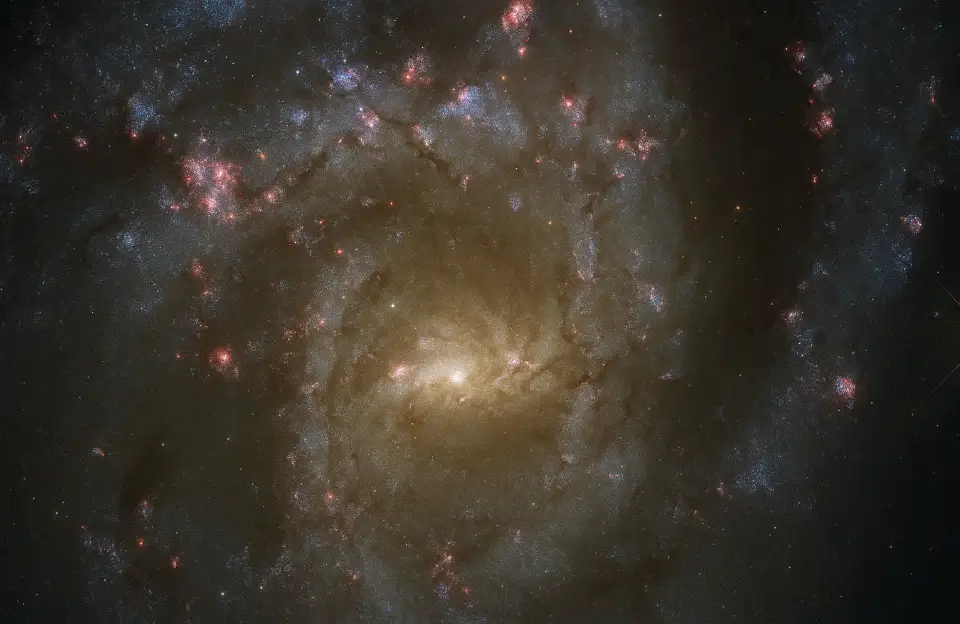
Hubble Space Telescope located 35 million light-years away in the Hydra constellation, NGC 2835 reveals glowing pink nebulae and vibrant star-forming regions.
The Hubble Space Telescope has captured a breathtaking new image of the spiral galaxy NGC 2835, located approximately 35 million light-years from Earth in the Hydra constellation. This latest observation highlights the intricate structure of the galaxy, from its spiral arms filled with young, bright blue stars to its elliptical core dominated by older stellar populations.
What sets this image apart from previous Hubble and James Webb Space Telescope observations is the inclusion of H-alpha wavelength data, a type of red light that traces active star formation. Across NGC 2835’s spiral arms, dozens of glowing pink nebulae appear to bloom like cosmic flowers, marking regions where new stars are rapidly forming.
But the impact of these star-forming regions may extend beyond NGC 2835 itself. Astronomers speculate that intense radiation and stellar winds from newborn stars could interact with intergalactic gas or even affect nearby satellite galaxies, potentially triggering secondary star formation in their outskirts. These cascading effects may offer clues about how galaxies influence one another across millions of light-years.
This observation is part of a larger Hubble survey designed to map over 50,000 nebulae across 19 nearby galaxies. By collecting such extensive data, scientists aim to better understand how stellar feedback mechanisms, including supernovae and stellar winds, shape the environments where stars are born. This, in turn, could shed light on galactic evolution, cosmic star formation cycles, and the interconnected dynamics of galaxies within clusters.
NGC 2835’s detailed imagery provides a rare glimpse into the complex interplay between old and young stars, gas, and dust, illustrating how galaxies are constantly evolving. As Hubble continues its survey, astronomers anticipate uncovering previously unseen phenomena, including the possible migration of star-forming regions between neighboring galaxies and the influence of massive stars on intergalactic ecosystems.
Ultimately, these findings not only enhance our understanding of NGC 2835, but also contribute to a broader picture of how spiral galaxies evolve, interact, and sustain star formation throughout the universe. Hubble’s ongoing observations continue to push the boundaries of our knowledge, revealing the delicate yet powerful processes that govern the life cycle of stars and galaxies alike.

Telescopes, both ground based and space based like the Hubble Space Telescope, play a crucial role in exploring the universe and expanding our understanding of celestial phenomena. Designed to collect and magnify light from distant objects, telescopes allow astronomers to study planets, stars, galaxies, nebulae, and other cosmic structures in extraordinary detail.
Space telescopes, such as Hubble, orbit above Earth’s atmosphere, which blocks certain wavelengths of light, enabling scientists to capture high resolution images in ultraviolet, visible, and near infrared spectra. Ground based observatories complement these observations with powerful instruments, adaptive optics, and long term monitoring programs that track the motion of stars, discover exoplanets, and detect transient events like supernovae.
Telescopes can operate for decades, gathering data over extended periods to study the evolution of galaxies, star formation rates, and the behavior of black holes. Whether designed for optical, radio, or X ray observations, telescopes are essential tools for measuring cosmic distances, mapping the structure of the universe, and identifying previously unknown celestial objects. From stunning images of spiral galaxies like NGC 2835 to the discovery of distant exoplanets and deep space phenomena, telescopes continue to revolutionize astronomy and inspire curiosity about the vast universe around us.
Telescopes, both space based like Hubble and ground based, are essential tools for exploring the universe. They allow astronomers to study planets, stars, galaxies, and other celestial objects in detail, capture high resolution images, discover exoplanets, and track cosmic events. Operating over decades, telescopes help measure cosmic distances, map the universe’s structure, and advance our understanding of phenomena like star formation and black holes, inspiring curiosity and scientific discovery.