
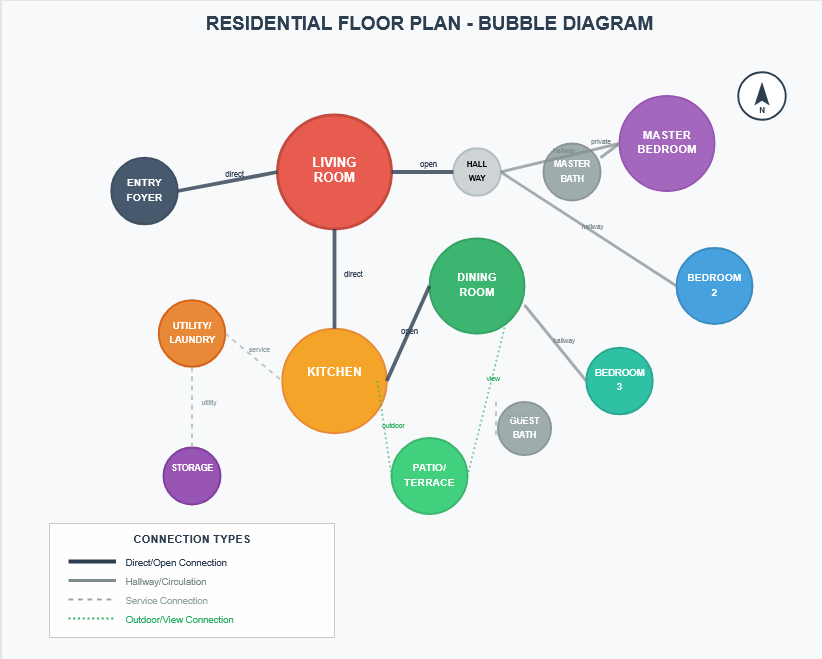
Bubble Diagram Methodology in Space Planning: A Comprehensive Guide to Spatial Design
- Bubble Diagram Methodology in Space Planning: A Comprehensive Guide to Spatial Design
- Table of Contents
- Chapter 1: Introduction and Fundamental Concepts
- Chapter 2: Overview of Space Planning Process
- Chapter 3: Criteria Matrix
- Chapter 4: Bubble Diagram Creation Process
- Chapter 5: Design Principles and User Experience
- Chapter 6: Transition from Bubble to Block Diagrams
- Chapter 7: Practical Applications
- Chapter 8: Common Mistakes and Solutions
- Chapter 9: Advanced Techniques
- Chapter 10: Digital Tools and Future Approaches
Table of Contents
Chapter 1: Introduction and Fundamental Concepts
1.2 The Importance of Bubble Diagrams
1.3 Purpose, Scope and Target Audience
1.4 Historical Background and Theoretical Framework
Chapter 2: Overview of Space Planning Process
2.1 Five-Stage Process: General Framework
2.2 Stage 1: Programming
2.3 Stage 2: Concept Development (Including Bubble Diagrams)
2.4 Stage 3: Design Development
2.5 Stage 4: Concept Presentation
2.6 Stage 5: Design Implementation
Chapter 3: Criteria Matrix
3.1 What is a Criteria Matrix?
3.2 Matrix Components
- 3.2.1 Function List
- 3.2.2 Quantity Determination
- 3.2.3 Area Requirements
- 3.2.4 Adjacency Relationships
3.3 Adjacency Classification
- 3.3.1 Primary Adjacency
- 3.3.2 Secondary Adjacency
- 3.3.3 Undesired Adjacency
3.4 Matrix Completion Techniques
3.5 Sample Application
Chapter 4: Bubble Diagram Creation Process
4.1 Material and Tool Preparation
4.2 Step-by-Step Process
- 4.2.1 Preparing Scaled Bubbles
- 4.2.2 Applying Coding Systems
- 4.2.3 Layout Exploration
- 4.2.4 Testing Multiple Options
4.3 Visualization and Drawing Techniques
4.4 Visual Coding Systems
- 4.4.1 Natural Light Requirements
- 4.4.2 Acoustic Privacy
- 4.4.3 Public/Private Space Distinction
4.5 Sample Application
Chapter 5: Design Principles and User Experience
5.1 Prioritizing Adjacency Relationships
5.2 Circulation Planning
5.3 Zoning Strategies
5.4 Flexibility and Iteration
5.5 Space Psychology and User Behaviors
Chapter 6: Transition from Bubble to Block Diagrams
6.1 Translation Process
6.2 Circulation Integration
6.3 Dealing with Structural Constraints
6.4 Legal Requirements
6.5 Sample Application
Chapter 7: Practical Applications
7.1 Residential Projects
- 7.1.1 Single Family House Example
- 7.1.2 Apartment Unit Example
7.2 Commercial Projects
- 7.2.1 Office Spaces
- 7.2.2 Retail Spaces
7.3 Educational and Healthcare Buildings
7.3.2 Clinic/Hospital Example
7.3.1 School/Campus Planning
Chapter 8: Common Mistakes and Solutions
8.1 Preconceived Approaches
8.2 Scaling Errors
8.3 Premature Detail Focus
8.4 Inflexible Interpretations
8.5 Solution Strategies
Chapter 9: Advanced Techniques
9.1 Multi-Story Projects
9.2 Phased Development
9.3 Outdoor Space Integration
9.4 Technology Integration
9.5 Sustainability Factors
Chapter 10: Digital Tools and Future Approaches
10.1 Traditional vs Digital Methods
10.2 Software Recommendations
10.3 BIM Integration
10.4 Parametric and Generative Design
10.5 VR/AR Applications
10.6 AI-Assisted Design
10.7 Future Trends
Why You Should Learn Bubble Diagram Techniques and How They Benefit Your Space Planning
Understanding and mastering bubble diagram techniques is essential for anyone involved in interior design, architecture, office management, or facility planning. Bubble diagrams provide a visual and strategic approach to organizing spaces, helping you see the relationship between different areas before committing to a final layout. By learning these 10 proven techniques, you can save time, reduce costly mistakes, and increase overall efficiency in your space planning projects.
Bubble diagrams are particularly valuable because they allow you to prioritize functionality, flow, and user experience. For example, in an office environment, properly planned spaces ensure employees have easy access to collaborative zones, private areas, and essential resources. In residential projects, bubble diagrams help create harmonious living areas where movement and interaction feel natural.
Moreover, mastering these techniques improves your decision-making and communication skills. You can present clear, visually intuitive layouts to clients, stakeholders, or team members, which helps in gaining approvals faster and reducing misunderstandings. With the increasing use of digital planning tools, combining bubble diagrams with software makes your workflow even more efficient and accurate.
In short, learning bubble diagram techniques is not just a design skill—it’s a strategic advantage. It empowers you to transform chaotic spaces into functional, visually appealing environments, enhancing productivity, comfort, and user satisfaction. Whether you are a professional or a student, this methodology equips you with the tools to plan spaces smarter, faster, and more creatively.
If you have understood this section, you can proceed to the next lesson.